
 Daniel Taylor
The digital landscape of 2026 has officially moved past the era of simple content creation and into the age of hyper-efficient synthesis.
For years, Private Label Rights content was the "secret weapon" for marketers who needed to scale, but it often came with a high cost to brand authority.
Most people would buy a PLR package, realize the writing was generic, and then spend dozens of hours manually trying to fix it... defeating the entire purpose of buying a shortcut in the first place.
The problem today isn't a lack of content; it is the lack of "high-signal" content that actually connects with a human audience while satisfying the sophisticated requirements of modern AI search engines.
If your content sounds like a dry manual from 2005, your audience will bounce before they even finish the first paragraph.
To win in 2026, you need to stop being a "content re-publisher" and start being a "content architect."
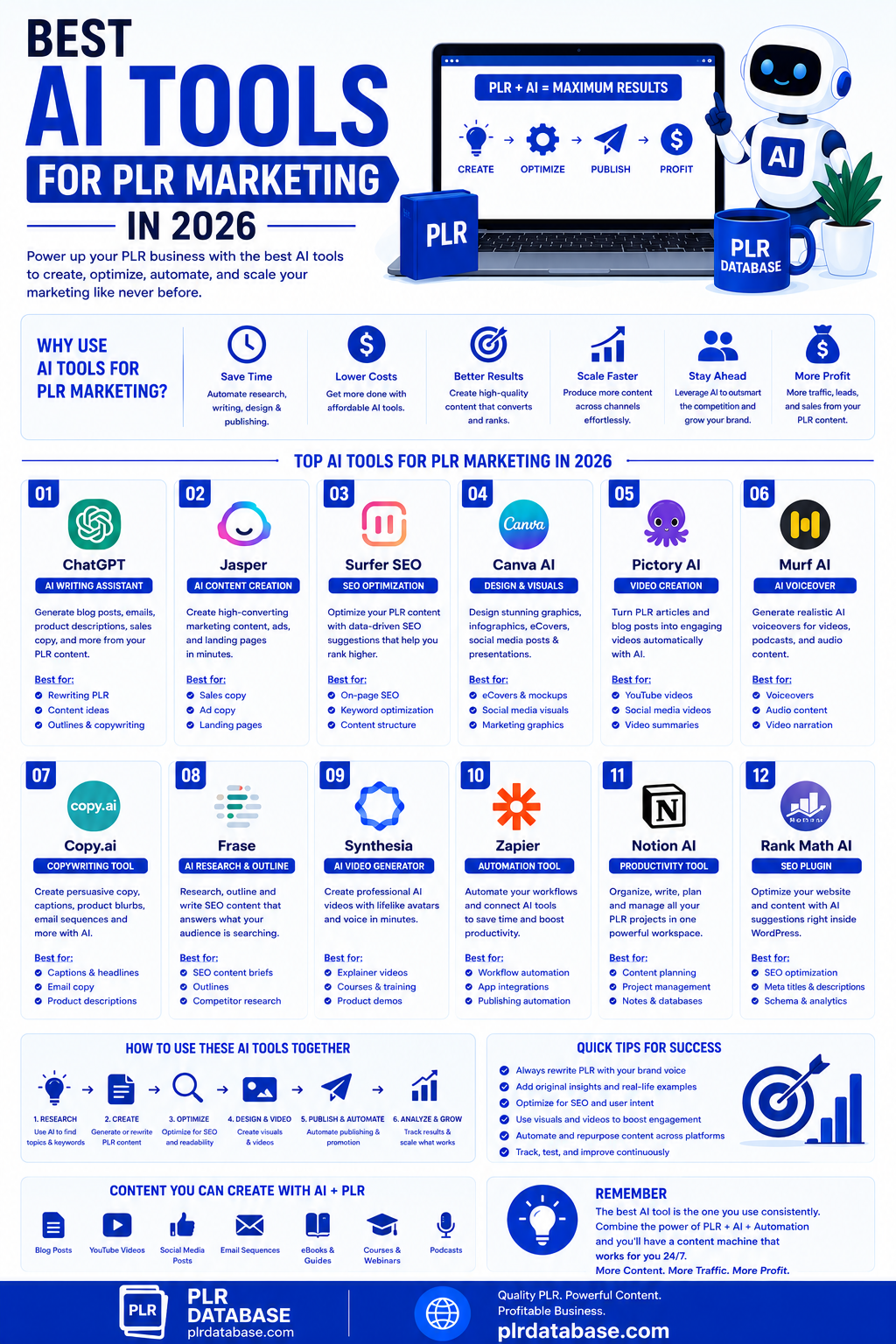
This lesson I'm presenting to you is designed to bridge that gap by introducing you to an elite stack of AI tools curated specifically for the PLR marketing ecosystem.
We're not just looking at basic chatbots; we're building a strategic system that uses specialized AI for structural deconstruction, semantic modernization, and multi-channel distribution.
By the end of this article, you will understand how to take a raw $20 PLR license and transform it into a premium, multi-format product line that commands high prices and builds long-term trust.
In This Article
The 2026 Shift: Why Specialized AI Tools are Non-Negotiable
In previous years, you might have gotten away with using a single AI tool for everything from research to final formatting. However, in 2026, the complexity of search algorithms and consumer expectations has reached a point where "generalist" outputs are easily flagged and ignored. To succeed in PLR marketing now, you need a specialized stack that treats your PLR source material as a raw ingredient rather than a finished product.
Specialized AI tools allow you to perform "Information Gain" analysis... a process that ensures your version of the content provides more value, more data, and more unique insights than the original source or any other version currently indexed on the web. This is what keeps you at the top of the search results and in the favor of your readers.
The necessity for specialized tools also stems from the rise of Answer Engine Optimization (AEO). Modern users aren't just scrolling through lists of links; they are asking AI assistants for direct answers.
If your repurposed PLR is just a fluff-filled rewrite, it will never be cited by these assistants. By using specialized AI for fact-checking and data-layering, you ensure that your content is recognizeable as an authoritative source.
This level of precision is impossible with basic tools. You need systems that can crawl the live web, verify 2026 statistics, and restructure text specifically for conversational search queries. It’s no longer about keywords; it’s about answering the intent behind the query with absolute accuracy.
Furthermore, the competitive landscape has shifted toward "Brand Personality." Customers in 2026 are increasingly wary of "faceless" content. Specialized AI tools now allow you to apply a consistent, hyper-realistic brand voice across every piece of content you produce.
This means your blog posts, your lead magnets, and your video scripts all sound like they came from the same human expert.
When you use a specialized AI stack to refine your PLR, you aren't just avoiding duplicate content; you are building a proprietary asset that carries the weight of a premium brand. This is the difference between a $10 ebook and a $500 flagship course that changes lives.
The Strategic Deconstruction Stack: Stripping PLR to Its Core
The first stage of a profitable PLR workflow is deconstruction. Most marketers make the mistake of trying to "edit" the PLR directly, which often results in a final product that still feels anchored to the original author's boring structure. In 2026, the elite marketers use "Reasoning Models" to strip the PLR down to its skeletal facts.
Tools like the high-reasoning versions of Gemini and Claude are perfect for this phase. You feed the AI the entire PLR package and instruct it to extract a "Knowledge Graph" of every hard fact, core concept, and actionable tip.
This process removes the outdated analogies and generic filler that usually plagues low-cost PLR, leaving you with pure, high-value information.
Once you have the raw data, you need a tool that can perform "Gap Analysis." This is where AI assistants with real-time browsing capabilities become essential. For example, if you are working with a PLR ebook on "Digital Marketing," you use your AI to compare the extracted facts against the current 2026 landscape.
The AI identifies what is missing... perhaps a section on "Privacy-First Tracking" or "AI-Generated Creative Optimization." By identifying these gaps early, you set the stage for a transformation that adds significant value to the original material. You are no longer just "spinning" words; you are performing a comprehensive content upgrade that makes your work stand out.
The deconstruction phase also includes a "Tone and Style Audit." Before you rebuild, you must use AI to identify the "stale markers" in the original text. Specialized AI editing tools can scan a 20,000-word PLR manuscript and highlight every instance of passive voice, overused marketing cliches, and repetitive sentence structures.
By stripping these away at the beginning, you ensure that the "base layer" of your new product is clean and ready for your unique brand voice. This architectural approach to content creation is what allows a single marketer to produce work that rivals a full editorial team in terms of quality and depth.
Semantic Modernization: Using LLMs to Inject 2026 Authority
Rebuilding your content requires "Semantic Modernization," which is the process of taking your extracted facts and weaving them into a narrative that resonates with today’s audience. In 2026, the gold standard for this is using "Persona-Driven Large Language Models." Instead of a generic prompt, you use sophisticated AI to apply a "Thought Leader" persona to your data.
For example, if your PLR is about "Real Estate Investing," you might instruct your AI to rewrite the content from the perspective of a "Contrarian 2026 Urban Developer." This forces the AI to use specific vocabulary, modern metaphors, and a tone that feels urgently relevant to the current market.
A key part of modernization is the "Live Data Loop." You should utilize AI tools that specialize in data retrieval to replace every generic claim in the PLR with a 2026 citation. If the PLR says "Many people are working from home," your AI should replace that with: "As of the Q1 2026 Labor Report, 42% of the white-collar workforce has shifted to a hybrid-asynchronous model."
This level of specificity is what wins the trust of both human readers and AI search bots. It proves that your content is not a recycled relic, but a fresh, authoritative resource. This is where the real conversion happens... when a reader realizes they are getting "insider" information that actually reflects the world they live in.
Finally, semantic modernization involves "Formatting for Flow." In 2026, the way content is consumed on mobile and desktop has shifted toward "Snippet-First" reading. You use AI to restructure your modernized text into "Cognitive Layers."
This means including executive summaries at the top of every section, bolding key insights for skimmers, and using AI to generate "Internal Hook" paragraphs that lead the reader seamlessly from one chapter to the next.
By using AI to optimize the "User Experience" of the text, you ensure that people actually read the content you’ve worked so hard to create. High consumption rates lead to high conversion rates and lower refund numbers.
The Visual and Multimedia Expansion Suite
In 2026, if your PLR product is "text-only," you are leaving 80% of your potential profit on the table. The most successful PLR marketers use a suite of generative AI tools to turn a single ebook into a multimedia ecosystem.
This starts with "Visual Identity AI." Instead of using the generic cover that came with your PLR, you use high-end image generators like the latest iterations of Nano Banana or Midjourney to create a bespoke visual brand.
This includes not just the cover, but custom infographics, conceptual diagrams, and internal illustrations that perfectly match the unique "2026 perspective" of your rewritten text. This visual consistency makes your product feel like a premium experience rather than a digital commodity.
The expansion continues with "Voice and Video Synthesis." You can take your modernized PLR chapters and feed them into AI video generators like Veo to create high-fidelity "Video Explainers."
A tip on "SEO for 2026" can be instantly transformed into a 60-second viral clip with a realistic AI spokesperson.
This allows you to dominate platforms like TikTok, YouTube, and LinkedIn without ever having to get in front of a camera. By using AI to create these "micro-assets," you build a massive presence that makes your brand feel much larger and more established than it actually is.
It creates an "omnipresence" that is absolutely essential for building trust in the 2026 market.
Lastly, you should utilize "Audio AI" to create high-quality audiobooks and podcast episodes from your transformed PLR. Modern AI voice models are now indistinguishable from human narrators, allowing you to offer an "Audio Upgrade" at your checkout for an easy 30% boost in revenue.
By offering your content in text, video, and audio, you cater to every learning style and maximize the "perceived value" of your product.
A customer might not want to pay $27 for a PDF, but they will happily pay $97 for a "Masterclass Bundle" that includes video lessons and an audio version they can listen to during their commute. Multi-format delivery is the key to premium pricing.
A Core Step-by-Step System for AI-Driven PLR Transformation
To make this practical, let's walk through the "Rapid Authority System" for transforming any PLR asset into a high-converting product. The first step is Extraction and Audit. Feed your PLR into a high-reasoning AI and ask for a "Thematic Map" and a "Fact Sheet."
For example, if you have a 3,000-word PLR article on "Sustainable Fashion," the AI will pull out the core principles mentioned. You then ask the AI to "Red-Flag" any advice that is more than two years old. This ensures your foundation is solid and gives you a clear list of what needs to be updated or replaced before you move forward. You want to build on solid ground.
The second step is Persona-Driven Reconstruction. Take your audited fact sheet and feed it into your specialized writing AI.
Tell the AI: "Using these facts as the only source of truth, write a 2,000-word authority guide in the voice of a sustainable luxury consultant. Focus on the 'ROI of Ethics' and use 2026 market examples."
This step is crucial because it ensures the AI isn't just "spinning" the original words, but is instead creating a brand-new narrative around the core concepts. This is how you achieve 0% similarity scores on plagiarism checkers while maintaining 100% of the value from your original PLR purchase.
You aren't just hiding the original; you are making something better.
The final step is Multimedia Atomization and Deployment. Take your final, polished text and use your visual and video AI tools to "atomize" the content. Turn the key takeaways into an infographic, the introduction into a short video script, and the case studies into a series of LinkedIn posts.
By the end of this 48-hour process, you haven't just rewritten an article; you have built a comprehensive marketing funnel. You have a lead magnet, a core product, and a month’s worth of social media content... all derived from a single PLR license and powered by a strategic AI stack.
This is how you out-work your competition without burning out.
Practical Use Cases and Tool Implementation
Let's look at how this system applies to a realistic business scenario. Imagine you are in the "SaaS for Small Business" niche. You buy a PLR package about "Customer Support Best Practices." Instead of just posting it to your blog, you use your AI stack to pivot the content.
You instruct the AI to rebuild the content specifically for "AI-Native Support Teams." The AI takes the general principles of customer service from the PLR and layers in modern 2026 workflows, such as "Automated Ticket Triaging" and "AI Voice-Agent Etiquette."
You have just turned a generic asset into a hyper-relevant guide for a cutting-edge audience that is willing to pay for expertise.
Another powerful use case is "Niche Product Flipping." You can find high-quality PLR in a broad niche like "Self-Improvement" and use AI to flip it into ten different sub-niches.
For example, a PLR guide on "Habit Building" can be transformed into versions for remote developers, single parents, or professional athletes.
For each version, you use AI to swap out the examples, the tone, and the "Pain Points" to match the specific audience.
This allows you to launch ten different products from one source, significantly increasing your "surface area" for potential sales. It’s about working smarter, not harder, by using AI as your niche-specialization engine.
In the world of affiliate marketing, you can use this system to create "High-Intent Bonus Packs." If you are promoting a new AI software, you can take PLR related to that software’s function (like "Video Editing") and use AI to create a custom "Bonus Masterclass" that shows users how to get the most out of the tool.
By using AI to polish and modernize the PLR, your bonus looks and feels like a premium $97 product. This dramatically increases your affiliate conversion rates because you are providing a unique, high-value reason for people to buy through your link rather than someone else's.
Five Fatal Mistakes to Avoid with AI and PLR
The most common mistake is "The Lazy Prompt Trap." This is when a marketer tells an AI to "rewrite this PLR" without giving it any context, persona, or updated data constraints. The result is almost always a bland, "middle-of-the-road" output that sounds like every other AI blog post on the web.
To avoid this, you must spend more time on your prompt than the AI spends on the writing. Give the AI specific boundaries, tell it what not to say, and always insist on a unique structural outline before it begins drafting the full text. Your prompt is your product.
The second mistake is "Ignoring the AI Search Fingerprint." In 2026, search engines are incredibly good at identifying patterns of "robotic" writing, even if the text is technically unique.
If your rewritten PLR uses the same repetitive sentence lengths and a generic "In conclusion" structure, it will be penalized.
To avoid this, you must use AI "stylization" tools that inject human-like variability into the prose. Better yet, do a "Manual Polish" on your headers and the first 100 words of every section to ensure there is a genuine human "hook" that leads the reader in. A little human touch goes a very long way in 2026.
Thirdly, many marketers fall into "The Information Decay" trap. They assume that because they used an AI to rewrite the PLR, the information is automatically "new."
However, if your AI doesn't have live-web access, it might just be rewriting old, incorrect information in a more modern voice.
Always verify the "Foundational Truths" of your PLR. If the source material says something that is no longer true in 2026, and your AI doesn't catch it, your authority will be destroyed instantly. Accuracy is the cornerstone of trust, and in 2026, trust is your most valuable asset.
Fourth is "Visual Disconnect." This happens when you have a high-quality, modernized text but you pair it with cheap, generic PLR graphics or 2010-era stock photos. This creates a "Cognitive Dissonance" for the buyer that makes them feel like they’ve been scammed.
In 2026, your visual brand must match the quality of your text. If you are selling a "Premium Guide," it must look premium. Use AI to generate bespoke visuals for every single asset in your funnel to maintain a cohesive, high-end aesthetic. Your brand is a promise; don't break it with lazy visuals.
Finally, the mistake of "Passive Distribution." Simply publishing your AI-enhanced PLR to a blog and waiting for traffic is a losing strategy in 2026. You must use AI to "Atomize" the content and push it out to the platforms where your audience actually lives.
Use AI to create a 30-day "social media drip" from your main article. Use AI to generate "Poll Questions" for LinkedIn and "Short-Form Scripts" for TikTok.
If you aren't using AI to multiply the reach of your content, you are only using 10% of the technology's true power. Distribution is what turns content into cash.
The 2026 Action Plan: From License to Launch
The era of "passive" PLR is over, but the era of "AI-Native PLR" is just beginning. To succeed, you must move from a mindset of "buying and posting" to a mindset of "buying and building."
Your strategy for 2026 should be built on the principle of "Information Gain"... always ensuring that your final product is objectively better, more current, and more useful than the source you started with.
By leveraging a specialized AI stack, you can achieve this level of quality in a fraction of the time it would take to write from scratch, giving you a massive advantage in any niche. Don't be afraid to have a strong opinion; in an AI world, personality is the ultimate differentiator.
Your action plan for the next 30 days is simple:
Week 1: Select a high-demand niche and purchase a premium PLR license. Perform your first "Extraction and Audit" to identify the core facts and the gaps.
Week 2: Use your specialized AI stack to perform "Persona-Driven Reconstruction," creating a unique, authoritative guide.
Week 3: Atomize that guide into a multimedia ecosystem... videos, audio, and graphics.
Week 4: Launch your funnel and begin your "AI-Driven Distribution" campaign. By following this system, you aren't just selling content; you are building a digital asset that will pay dividends for years to come. Start today, and let AI do the heavy lifting while you focus on the strategy and the sales.
About the Author







0 Comments
Start The Conversation