
 Daniel Taylor
The digital publishing world in 2026 has officially entered a zero-tolerance phase for low-effort content. For years, Private Label Rights material was marketed as the ultimate shortcut to internet riches.
Marketers bought affordable text bundles, pasted them directly into their sites, and expected easy search rankings and affiliate commissions to materialize overnight.
Today, that legacy approach is digital suicide. The internet is flooded with generic text, and modern conversational search engines are explicitly engineered to filter out unoriginal, recycled information.
If your content offers the exact same layout and generic definitions as a thousand other websites, it serves no structural purpose in the modern web ecosystem.
The problem isn't the foundational data inside your PLR pack; it is the complete absence of original value, modern authority, and targeted positioning.
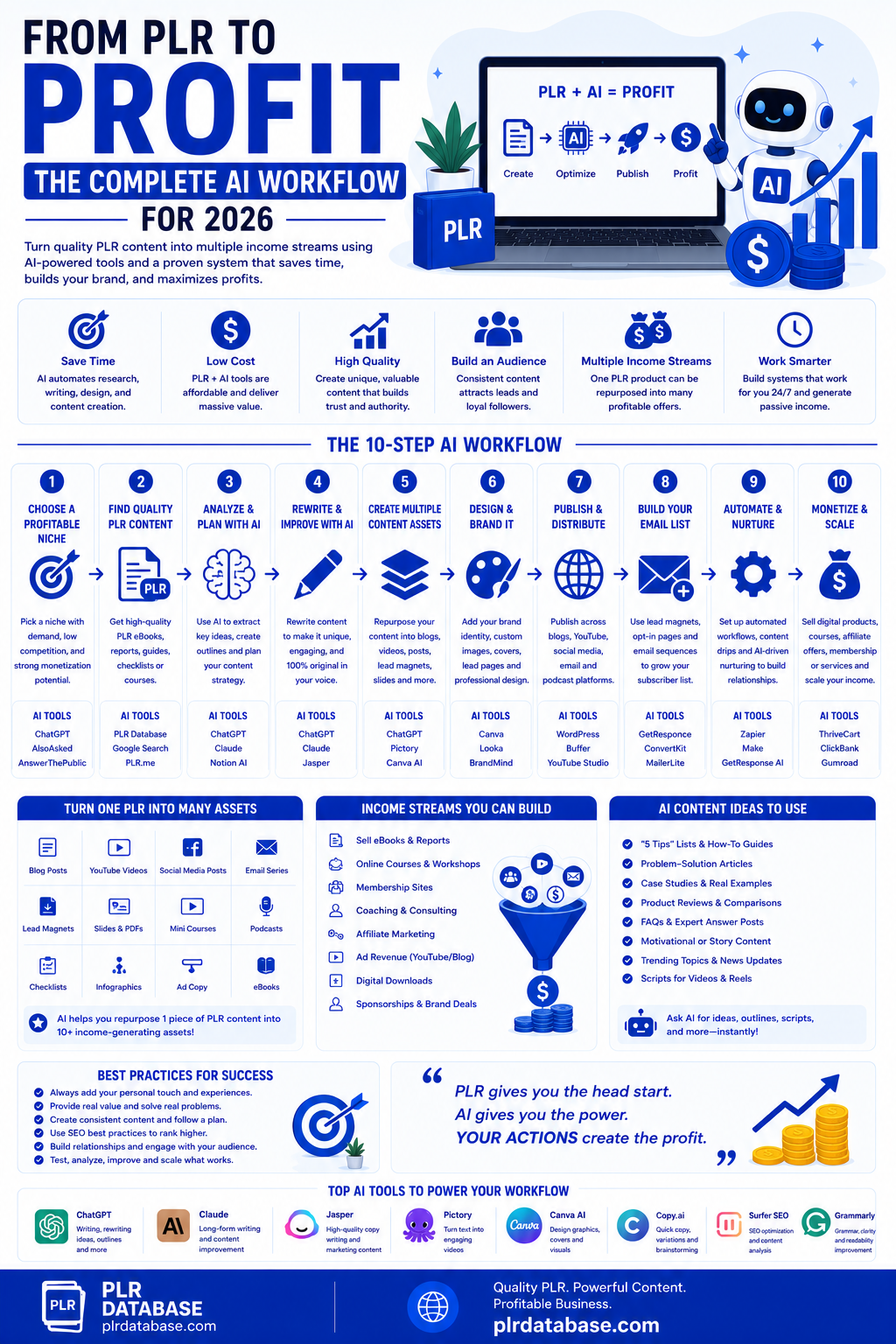
To build a highly profitable information business now, you must treat licensed material as raw research and use advanced artificial intelligence as your high-speed refinery.
This article delivers a comprehensive, field-tested workflow to transform sterile PLR into high-signal digital assets. You will discover a practical system to rewrite the DNA of your licensed assets, build deep brand authority, and maximize direct-response conversions.
We are moving beyond basic text spinning into an era of advanced product engineering that captures traffic, converts casual readers, and builds massive digital leverage on autopilot.
In This Article
The Death of Commodity Text and the New Rules of Information Gain
The market value of raw, basic information has completely bottomed out. Consumers no longer need to click through ten blue links to understand core concepts because they can simply ask a conversational search assistant for an immediate summary.
If your website or digital product merely echoes basic textbook definitions, you are completely invisible to the current web ecosystem.
To rank in modern answer engines and convert skeptical human readers, your content must provide significant information gain.
This means you must add new data points, unique perspectives, and actionable insights that cannot be generated by a basic, unprompted chatbot.
When you look at raw PLR content through this lens, you realize it is far too generalized to survive in an authoritative search landscape. Most PLR ghostwriters purposefully write text to be as broad as possible so it can apply to thousands of diverse buyers.
Rebranding this material means using advanced Large Language Models to strip away the academic prose and reshape the data into a custom, premium solution.
By doing this, you instantly elevate the perceived value of your offer. A generic personal finance ebook might sit unnoticed on a digital shelf, but an AI-synthesized, highly specialized wealth roadmap tailored directly to freelance software engineers becomes an urgent, irresistible purchase.
Ultimately, monetization in 2026 is dependent on building authentic trust. Faceless data fails to convert because buyers want distinct perspectives and real-world execution tracks.
When you run a generic PLR outline through a highly structured AI workflow, you infuse it with a distinct brand voice and sharp, contrarian opinions.
This strategic upgrade changes your positioning from a transparent reseller into a definitive thought leader. You stop competing on the sheer volume of words you can hit publish on, and you start winning on the high-ticket clarity of your curated execution.
Phase 1: Deep Deconstruction and Semantic Fact Extraction
The baseline of our profit workflow requires the absolute destruction of your purchased PLR document’s original presentation layer. Most amateur marketers log into an AI tool, upload a PLR file, and use a weak prompt like "rewrite this chapter to sound better." This superficial approach is a critical mistake.
It forces the AI to inherit the boring pacing, linear explanations, and predictable vocabulary of the original ghostwriter.
To build a digital asset that commands premium conversions, you must perform a deep semantic deconstruction to extract the core knowledge graph hidden beneath the surface fluff.
You execute this phase by feeding your raw PLR text into a high-reasoning model and instructing it to act as an aggressive research editor. Command the AI to ignore all introductory filler, generic marketing adjectives, and smooth transition paragraphs.
Instruct it to output an unformatted, highly concentrated bulleted list consisting entirely of hard principles, core logic, and physical execution steps.
For example, if you are processing a standard PLR pack on email copywriting, your AI should completely bypass the long-winded histories of the internet and strictly pull out the explicit metrics regarding subject line length limits, open-rate data loops, and psychological urgency anchors.
This deconstruction process leaves you with a pristine, unpolluted fact sheet that serves as your single source of truth. By stripping away the style of the original author, you ensure that the AI has complete creative freedom when it rebuilds the content later in the workflow.
You are separating the "meat" of the content from its original, stale "skin."
This clean framework ensures that your final output shares 0% structural similarity with the source material, making duplicate content tracking issues mathematically impossible while preserving 100% of the foundational research value you purchased.
Phase 2: Algorithmic Upgrading and Live Data Modernization
Once your raw fact sheet is isolated, you must execute an aggressive modernization pass before writing a single line of client-facing copy. PLR packages can languish in digital warehouse vaults for years before you buy them, which means the statistics, tool recommendations, and historical case studies inside are often dangerously obsolete.
In the current search landscape, accuracy and fresh citations are hard ranking factors. If your content references a market statistic from five years ago as current data, answer engines will downgrade your entire domain trust score instantly.
To fix this, you must deploy a search-enabled AI tool to act as your data validator. Instruct the AI to crawl your raw fact sheet, challenge every single metric, and search the live web for current data points.
For instance, if you are updating an old digital marketing guide that mentions baseline click-through rates, your search AI should automatically find current benchmarks and insert them as fresh citations.
Writing phrases like "according to recent market studies updated in Q1 of 2026" signals massive algorithmic and human authority, immediately separating your product from competitors who rely on outdated information.
Beyond simple metrics, the modernization phase requires you to execute a "Gap Analysis." Instruct your live-search model to analyze the top-ranking web results for your core topic and identify what new sub-trends have emerged since the PLR was originally written.
If your real estate PLR fails to discuss predictive fractional investing or modern tokenized structures, the AI will highlight those empty slots. The model then drafts supporting information to fill those gaps.
This upgrade injects massive original value into the content, ensuring that your finished product is objectively superior to the original licensed material.
Phase 3: The Hyper-Targeted Audience Pivot and Voice Stamping
The true magic of the AI-driven PLR workflow lies in your ability to execute a hyper-targeted positioning pivot. Mass-market informational products carry no premium value because the modern consumer knows they can pull general definitions from a chatbot in seconds.
To command high conversion rates and charge premium prices, you must intersect your modernized facts with the hyper-specific pain points of a highly focused customer avatar. This synthesis completely re-contextualizes the data to feel personal, urgent, and tailored.
Let us look at a realistic example in the productivity niche. Imagine you buy a standard PLR book centered on the Pomodoro Technique and time-blocking.
Instead of publishing a generic guide for everyone, you instruct your AI engine to merge these time-blocking data points with the exact behavioral constraints of work-from-home graphic designers who manage multiple asynchronous freelance clients.
The AI will naturally pivot the text, transforming generic advice about setting desk timers into specialized workflows that discuss how to balance creative deep-focus design blocks while managing client communication fatigue.
The underlying logic of the time-block stays completely intact, but the execution becomes remarkably distinct.
To lock this positioning in, you must apply a distinct brand voice stamp over the text. Provide your AI engine with a strict linguistic blueprint that explicitly outlines your tone, sentence length variations, and specific narrative rules.
If your target identity is confident, analytical, and highly conversational, instruct the AI to write using punchy sentences, real-world analogies, and zero corporate jargon.
Explicitly ban generic machine vocabulary like "it is crucial to understand" or "delve deep into the world of." This pass forces the model to produce clear, sharp human prose that builds an immediate personal connection with your readers.
Phase 4: Multimedia Atomization and Multi-Channel Funnel Construction
The ultimate profitability of your modernized asset is realized when you move beyond a single blog post and engage in format atomization. One 5,000-word PLR ebook should never just remain a static document; it should serve as the core intelligence hub for an entire multi-channel marketing funnel.
You must use your AI stack to break the primary asset down into multiple high-converting formats, ensuring that your brand maintains a dominant presence across the distinct platforms where your target audience consumes content.
Instruct your AI model to analyze your updated text and instantly generate a 5-part email welcome sequence, 10 high-engagement social updates, and a complete text script for a short video or presentation.
Because the AI pulls from the exact same modernized source of truth, your core message and brand voice remain entirely consistent across every touchpoint.
For instance, you can prompt the AI to take a deep-dive chapter regarding cash flow optimization and re-engineer it into a highly interactive scorecard or a multi-step checklist that users can download as an opt-in lead magnet.
This multi-channel funnel construction builds what direct-response marketers call an "Echo Chamber Effect."
A prospect might encounter your short video clip on social media, click the link in your bio to download your interactive checklist lead magnet, and immediately enter your automated email machine.
Every email they receive delivers a localized value bomb derived from your core PLR asset, steadily warming them up for your high-ticket paid flagship bundle.
You are using the infinite scaling efficiency of generative AI to run a comprehensive media empire, treating an inexpensive licensed asset as the ultimate seed for exponential brand growth.
The 2026 AI Production Stack: Practical Tools and Implementations
Running this high-yield digital refinery at peak performance requires a specialized assembly line of modern generative applications. For the initial phase of deep semantic deconstruction, a high-reasoning model like Gemini 3 Flash serves as your primary operational engine.
Its massive context window allows you to upload entire multi-module PLR libraries or long-form manuals in a single pass, cleanly isolating the hidden structural facts from the surrounding conversational filler without losing the logical thread of the material.
When you transition into the copywriting and formatting phase, you should employ your visual generative engine to handle your brand’s presentation layer.
You can deploy tools like Gemini 3 Flash Image to create highly polished 3D product mockups, clean internal illustrations, and modern minimalist site headers.
By defining a unified style guide within your visual prompts—such as specifying a precise corporate navy and ice-white color scheme—the AI will produce a cohesive visual framework that instantly differentiates your asset from the cheesy, outdated stock templates distributed by standard PLR networks.
For a highly practical implementation scenario, consider an online business consultant who acquires a generic PLR guide regarding corporate cash flow.
By utilizing this tools stack, the marketer can extract the baseline accounting principles and instantly pivot them into "The Solo Agency Cash Burn Rate Diagnostic Spreadsheet."
The AI handles the heavy lifting of writing the custom calculator formulas, drafting the text instructions, creating the high-converting landing page copy, and generating the five-day email sequence.
In a few hours of strategic orchestration, a dusty, commoditized file becomes a premium lead generator that captures targeted traffic on autopilot.
Five Fatal Workflow Mistakes That Destroy PLR Profits
The most common mistake is relying on a simple single-pass rewrite. Many marketers assume that uploading a PLR article to an AI tool and typing "rewrite this" is enough to create a unique piece of content.
This lazy approach produces a superficial makeover that retains the exact same paragraph structures, sequential logic, and conceptual pacing as the source text.
Search engine crawlers can easily see through this cosmetic change. You must always use a multi-pass approach: first extract the raw facts, then reorder the outline, and finally write the new copy from scratch using your unique brand voice.
Second is ignoring mobile scannability and consumption patterns. Over eighty percent of your target audience will likely review your landing page and consume your content on a mobile screen while multitasking.
If your AI-generated text features massive, blocky paragraphs and dense academic language, you will trigger an immediate bounce response.
You must explicitly prompt your AI model to use micro-copy styling. Insist on short sentences, frequent line breaks, bolded key takeaways, and clear visual breaks that allow a user's thumb to move through your emails and guides effortlessly.
Thirdly, many creators fail to install a seamless transition loop to their paid offer. They build a beautiful, independent piece of content or a free lead magnet that provides great value but leaves the reader at a dead end.
Every single asset you build must contain a strategic call to action that naturally flows into the next premium logical step.
Use your AI engine to craft an elegant concluding section that explains how your core paid product or service accelerates the exact process they just practiced, turning a casual reader into an immediate customer.
Fourth is relying on default, sanitized chatbot prose. If your transformed content or email sequence is littered with robotic filler phrases like "in today's fast-paced digital age," "unleash your potential," or "it is crucial to remember," your audience will spot the automated nature of your content.
This robotic styling completely kills the personal trust connection required to build an online business.
You must implement a strict negative prompt profile within your workspace that explicitly bans these predictable machine phrases, forcing the model to produce clear, sharp human prose.
Finally, the mistake of passive fact-matching will destroy your reputation. If your underlying PLR contains an old tool recommendation or an inaccurate statistic, and you allow your AI to simply rewrite that claim without a live-search challenge, your product is flawed from day one.
When subscribers discover factual errors in your materials, they will instantly hit the unsubscribe button or bounce from your site, destroying your brand trust. Treat your AI tool as a strict editor that aggressively challenges the validity of every metric in the source PLR pack.
Conclusion: Your 72-Hour Blueprint for Market Domination
Transforming raw Private Label Rights documents into high-value, totally unique digital assets is an exercise in strategic execution. In the modern content landscape, the winners are those who can synthesize information with extreme speed while maintaining an undeniable human edge.
By leveraging the modular AI system of deconstruction, modernization, and visual synchronization outlined in this guide, you can comfortably out-produce your competitors while building an authoritative digital footprint that lasts.
Your 72-Hour Execution Blueprint:
- Hours 1–12: Sourcing and Deep Deconstruction
Audit your current licensed catalog or purchase a high-quality, evergreen PLR package centered on a proven market demand. Feed the text into your high-reasoning model to strip away the conversational fluff, extracting a clean, unformatted knowledge graph of raw conceptual data anchors.
- Hours 13–36: Live Modernization and Niche Positioning Pass
Deploy a search-enabled AI tool to verify and update every stat, tool recommendation, and case study to current standards. Intersect this modernized fact sheet with a specific customer avatar persona prompt, pivoting the vocabulary, examples, and emotional narrative hooks to fit that exact community.
- Hours 37–60: Re-Engineering and Format Conversion
Instruct your AI engine to transform the updated prose into multiple assets, such as a deep-dive blog post, a 5-part email sequence, and short-form social updates. Run the resulting text through your generative visual engine to apply a clean, unified brand style guide across all headers, icons, and 3D product mockups.
- Hours 61–72: Funnel Assembly and Deployment
Assemble your finished pages within your publishing platform, hook up your digital product delivery channels, and run live test loops to ensure your automated sequences trigger flawlessly. Once cleared, launch your first topic cluster to start feeding your high-converting funnel with high-intent organic traffic.
By adhering to this disciplined framework, you cease to be a passive reseller of generic digital text. You become a high-speed content architect, using advanced technology to maximize your efficiency while building a distinct, authoritative brand identity that commands long-term audience monetization.
The blank page is no longer a blocker to your growth. Take this system, process your next licensed asset, and watch your automated machines transform from quiet pages into high-converting revenue engines.
About the Author








0 Comments
Start The Conversation