
 Daniel Taylor
The absolute core of any resilient digital marketing business is an owned email list. For decades, PLR content was the go-to asset for building that list quickly.
Marketers would buy an inexpensive PLR pack, put the unedited text behind a basic opt-in form, and expect a flood of highly qualified subscribers.
In 2026, that traditional playbook is completely broken. Consumers suffer from intense digital fatigue, and they guard their email addresses with extreme skepticism.
If your lead magnet looks, sounds, or reads like a generic document from five years ago, users will bounce from your page instantly. Worse yet, AI-native search engines won't even bother indexing your landing page.
The problem isn't the PLR itself; it is the total lack of semantic depth, modern data, and clear positioning.
To build an elite subscriber asset today, you must treat PLR as raw research material and use generative AI to transform it into high-signal lead generation systems.
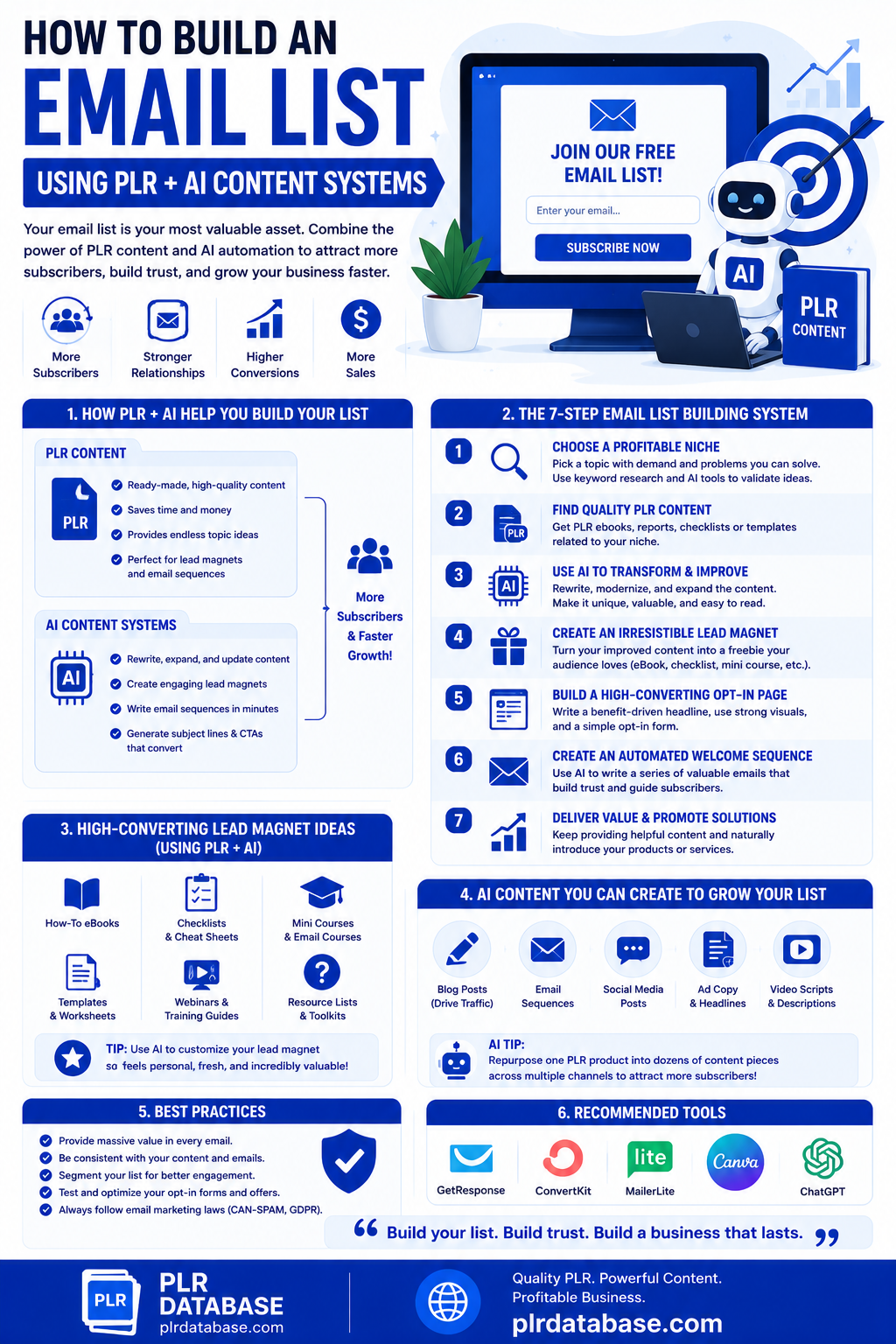
This comprehensive guide teaches you a practical, repeatable architecture to turn licensed content into high-converting email list machines.
You will discover how to restructure static text into hyper-targeted utility assets, engineer automated opt-in funnels, and write high-converting welcome sequences that turn cold subscribers into raving buyers.
We are moving past low-effort content flipping and stepping into advanced list engineering.
In This Article
The Death of the Generic PDF: List Building Realities in 2026
The market value of raw information has dropped to zero because consumers can ask any conversational AI search tool for immediate answers to general queries. If your lead magnet promises a basic "Guide to Digital Marketing," it carries absolutely no perceived value.
Your prospect knows they don't need to hand over their email address to learn the definitions of SEO or conversion rates.
To earn an opt-in today, your lead generator must provide genuine information gain. It needs to offer a hyper-specific solution to a precise problem, wrapped in a format that delivers a tangible win within five minutes of downloading.
If it takes longer than that to get value, your prospect is already gone.
Furthermore, AI search engines evaluate your lead generation assets based on their unique contribution to the web's knowledge graph.
If your opt-in page features the exact same generic headlines and baseline text copy as five hundred other affiliate sites using the same PLR pack, it will never rank in AI search overviews.
Re-engineering your PLR with advanced Large Language Models allows you to bypass this algorithmic filter.
You can take broad, sterile text and infuse it with live 2026 data loops, predictive trends, and a distinct, authoritative brand voice that commands human attention and algorithmic visibility.
Ultimately, list building is about forging a relationship, not just collecting data lines in a software dashboard.
If your free asset is low-signal, your subscribers will instantly click unsubscribe or send your emails straight to the spam folder.
When you use AI to inject deep expertise, real-world analogies, and contrarian perspectives into your foundational PLR, you transform the asset from a transparent commodity into a premium consultation.
You set a massive expectation for your paid products by over-delivering on your free value, which is the exact strategy that drives massive backend conversions and long-term customer lifetime value.
Step 1: The AI Deconstruction and Semantic Fact Extraction
The first phase of our high-converting list building system requires a complete structural demolition of your purchased PLR package. Most marketers make the fatal error of opening a PLR file and editing it sequentially, polishing a sentence here and there while keeping the original author's layout.
This lazy approach preserves the boring pacing and linear explanations of the source material. To build an asset that converts, you must strip away all the generic introductory fluff.
Feed your raw PLR files into a high-reasoning model like Gemini 3 Flash and instruct it to extract a clean, unformatted knowledge graph consisting entirely of hard metrics, underlying logic, and actionable strategies.
For example, if you buy a standard PLR package on "Time Management," you should instruct your AI to ignore the long-winded histories of productivity and strictly isolate the underlying data loops of specific frameworks, like time-blocking parameters or cognitive energy cycles.
Once you have this clean, extracted fact sheet, you must run a live-web modernization loop using a search-enabled AI tool. PLR packages often sit in digital vaults for years, meaning their statistics and tool references are hopelessly obsolete.
By forcing your AI to cross-reference your fact sheet with current market data, your foundational information becomes completely current and authoritative before you create a single opt-in page.
With your verified data sheet ready, you must execute a hyper-targeted positioning pivot. Take the broad concepts from the PLR and instruct your AI to align them with the specific, intense pain points of a highly focused customer avatar.
Instead of a general guide for everyone, pivot your time management facts into something like "The Asynchronous Deep-Work Framework for Remote Project Managers Managing Global AI Tech Teams."
The fundamental core mechanics of the productivity advice stay completely intact, but the contextual positioning becomes intensely urgent, highly specialized, and impossible to replicate with a generic search prompt.
Step 2: Transforming Text Into Actionable Micro-Utilities
Once your core knowledge is modernized and targeted, you must choose a consumption format that emphasizes rapid behavioral implementation. In 2026, consumers rarely read 50-page ebooks on their mobile screens while multitasking.
Long-form reading has been largely replaced by automated tools, interactive scorecards, and high-velocity diagnostic frameworks.
You must use your AI model to re-engineer the plain prose of your updated PLR text into highly actionable micro-utilities that give your subscriber an immediate, undeniable win.
A powerful formatting strategy is translating an informational chapter into an interactive "Diagnostic Audit Scoring Rubric."
If your PLR text describes the five elements of a successful email campaign, do not just list those elements in a static document.
Instead, prompt your AI model to turn those core concepts into a scoring rubric called "The High-Converting Email Deliverability Audit Checklist."
This structural shift forces the user to actively participate with your content, grading their own business or lifestyle choices and discovering their specific weaknesses in real-time.
Furthermore, you should use your visual generative engines to construct a clean, cohesive visual framework for this interactive utility. If your AI writes a premium tracking checklist from your PLR data, run that text through an automated design layout tool to generate minimal, high-contrast assets.
When you frame your specialized data inside a beautiful, scannability-optimized visual ecosystem, the perceived value of your lead magnet climbs exponentially.
You are no longer presenting raw, recycled words; you are delivering a premium execution tool that provides real-world value and leaves the subscriber eager for your paid upsells.
Step 3: Engineering the High-Signal Welcome and Monetization Sequence
The moment a prospect enters their email address into your high-converting landing page, you have entered the most critical phase of the list building lifecycle: the first 72 hours. Most marketers capture the lead and then send a single generic email with a download link, entirely wasting the period of highest customer intent.
To maximize your digital marketing revenue, you must use your AI engine to construct an automated 5-part "Indoctrination and Monetization Sequence" written in your distinct brand voice.
The first email must deliver the micro-utility immediately without any friction, but it should also include an "Authority Story" that sets the stage for your brand.
Instruct your AI copywriter to use the raw concepts from your PLR to explain exactly why you created this specific diagnostic tool and what a typical user can expect to achieve if they implement the advice over the next 48 hours.
This email shifts the consumer's perspective from a passive downloader into an active student of your brand. You are establishing yourself as an expert right out of the gate.
The subsequent emails in the automated machine should use the remaining modules of your modernized PLR package to deliver unannounced value bombs, directly addressing the core objections and hidden frustrations of your niche.
By email four, your sequence should construct an elegant transition loop into your core paid offer, demonstrating how your premium product or service completely automates, scales, or accelerates the exact framework they just practiced in the free lead magnet.
This automated value loop transforms your email list from a static line of contacts into a dynamic, highly responsive monetization engine.
The 2026 List Building Stack: Practical Tools and Implementations
Running this high-yield list building engine without drowning in manual labor requires a specialized stack of generative applications. For the initial phase of deep deconstruction and conceptual extraction, a high-reasoning engine like Gemini 3 Flash serves as your primary operational tool.
Its massive context window allows you to upload entire multi-module PLR libraries in a single pass, cleanly isolating the essential facts from surrounding conversational filler while perfectly maintaining the logical thread of the training material.
When you transition into the copywriting and formatting phase, you should employ your visual generative engine to handle your brand's presentation layer.
You can deploy tools like Gemini 3 Flash Image to create highly polished 3D product mockups, clean chapter headers, and custom funnel icons.
By defining a unified style guide within your visual prompts... such as specifying a precise minimalist slate and electric-gold color scheme, the AI will produce a cohesive visual framework that instantly differentiates your asset from the cheesy, outdated stock templates distributed by standard PLR networks.
For a practical implementation scenario, imagine a direct-response marketer targeting the "SaaS Startup Founder" niche. They acquire a premium PLR package centered on customer acquisition.
By deploying this modern tools stack, the marketer can extract the baseline sales mechanics and instantly pivot the angle into "The B2B SaaS Customer Acquisition Burn Rate Scorecard."
The AI handles the heavy lifting of writing the custom questionnaire, drafting the score parameters, creating the high-converting landing page copy, and generating the five-day email sequence.
In a single afternoon, a raw text file becomes a fully weaponized list-building machine ready to capture targeted traffic on autopilot.
Five Fatal List-Building Mistakes to Avoid
The most common mistake is delivering an unedited data dump. Marketers often assume that because a PLR package contains a high volume of information, it will automatically make a great lead magnet. In reality, handing a prospect a massive, text-heavy file is like giving someone a box of raw car parts instead of a working vehicle.
If your opt-in requires hours of reading to extract the first drop of value, your completion rate will be zero. You must use AI to condense, refine, and focus the source text down to its most potent, immediately useful core expression.
Second is ignoring mobile scannability and consumption patterns. Over eighty percent of your target audience will likely review your landing page and open your lead magnet on a mobile screen while multitasking.
If your AI-generated text features massive, blocky paragraphs and dense academic language, you will trigger an immediate bounce response. You must explicitly prompt your AI model to use micro-copy styling.
Insist on short sentences, frequent line breaks, bolded key takeaways, and clear visual breaks that allow a user's thumb to move through your emails and guides effortlessly.
Thirdly, many creators fail to install a seamless transition loop to their paid offer. They build a beautiful, independent lead magnet that provides great value but leaves the reader at a dead end. Every single opt-in asset you build must contain a strategic call to action that naturally flows into the next premium logical step.
Use your AI engine to craft an elegant concluding section that explains how your core paid product or service accelerates the exact process they just practiced in the lead magnet, turning a free subscriber into an immediate customer.
Fourth is relying on default, sanitized chatbot prose. If your transformed lead magnet or email sequence is littered with robotic filler phrases like "in today's fast-paced digital age," "unleash your potential," or "it is crucial to remember," your audience will spot the automated nature of your content.
This robotic styling completely kills the personal trust connection required to build an email business. You must implement a strict negative prompt profile within your workspace that explicitly bans these predictable machine phrases, forcing the model to produce clear, sharp human prose.
Finally, the mistake of passive fact-matching will destroy your reputation. If your underlying PLR contains an old tool recommendation or an inaccurate statistic, and you allow your AI to simply rewrite that claim without a live-search challenge, your product is flawed from day one.
When subscribers discover factual errors in your materials, they will instantly hit the unsubscribe button and report your email as spam, destroying your domain deliverability rates.
Treat your AI tool as a strict editor that aggressively challenges the validity of every metric in the source PLR pack.
The 30-Day Automated Action Plan: From Licensed Text to Active Subscribers
Transforming a commoditized Private Label Rights document into an authoritative, high-converting list-building engine is an exercise in focused execution. In the modern information economy, the advantage belongs to creators who can use advanced technology to maximize their speed to market without reducing their human authority.
By executing this disciplined, modular framework, you can continuously populate high-converting funnels across multiple profitable niches in a fraction of the time required to build an asset from scratch.
The 30-Day Blueprint
Days 1–7: Sourcing and Deep Deconstruction
Select a high-quality PLR bundle centered on a proven market demand like health, wealth, or relationships. Run the text through your high-reasoning AI to strip away all fluff, extract the raw facts, and deploy search-enabled AI to modernize every statistic to clear standards. Pivot the entire message to target a hyper-focused customer avatar.
Days 8–15: Micro-Utility Re-Engineering
Instruct your AI engine to transform the updated prose into an interactive utility format, such as a diagnostic checklist, scorecard, or micro-audit framework. Run the resulting text through your generative visual engine to apply a clean, unified brand style guide across all headers and product wrappers, completely wiping out the original PLR aesthetic.
Days 16–22: Direct-Response Funnel Copywriting
Deploy your automated writing engine to process your landing page copy and your automated 5-part welcome sequence. Focus on the PAS (Problem, Agitate, Solution) copywriting framework to ensure your headlines and email hooks speak directly to the target avatar's primary fears, avoiding all generic machine filler words.
Days 23–30: Technical Integration and Traffic Deployment
Assemble your landing pages inside your email marketing platform, connect your digital product delivery channels, and run test loops to ensure your automated sequences trigger flawlessly upon opt-in. Once cleared, launch your first topic cluster on your blog or run targeted social ad waves to drive high-intent traffic directly into your new automated list-building machine.
By adhering to this rigorous blueprint, you step completely away from the low-margin hustle of content spinning and become a high-velocity digital content architect.
You are using the infinite scaling efficiency of generative AI to transform a simple licensed asset into premium, highly protective digital real estate.
The blank page is no longer a blocker to your growth. Take this system, process your licensed asset, and watch your opt-in forms transform from quiet pages into high-converting email acquisition engines.
About the Author








0 Comments
Start The Conversation