
 Daniel Taylor
The digital landscape of 2026 has become an ecosystem where "average" content goes to die. For years, Private Label Rights content was the ultimate shortcut for busy marketers, promising a library of ready-made products for pennies on the dollar.
However, the dream of "copy-paste" profits has turned into a technical nightmare.
Search engines have evolved far beyond simple keyword matching. They now employ sophisticated semantic analysis to sniff out unoriginal material. If you simply buy a PLR pack and hit "publish," you aren't just wasting your money... you are actively damaging your domain's reputation. The harsh reality is that thousands of other marketers are likely hitting "publish" on that exact same text at the very same time.
This article is designed to solve that problem once and for all. We are moving beyond the era of "spinning" and into the era of "AI-driven reconstruction."
By combining the foundational research of PLR with the creative synthesis of advanced AI, you can produce content that is technically unique, semantically deep, and highly profitable.
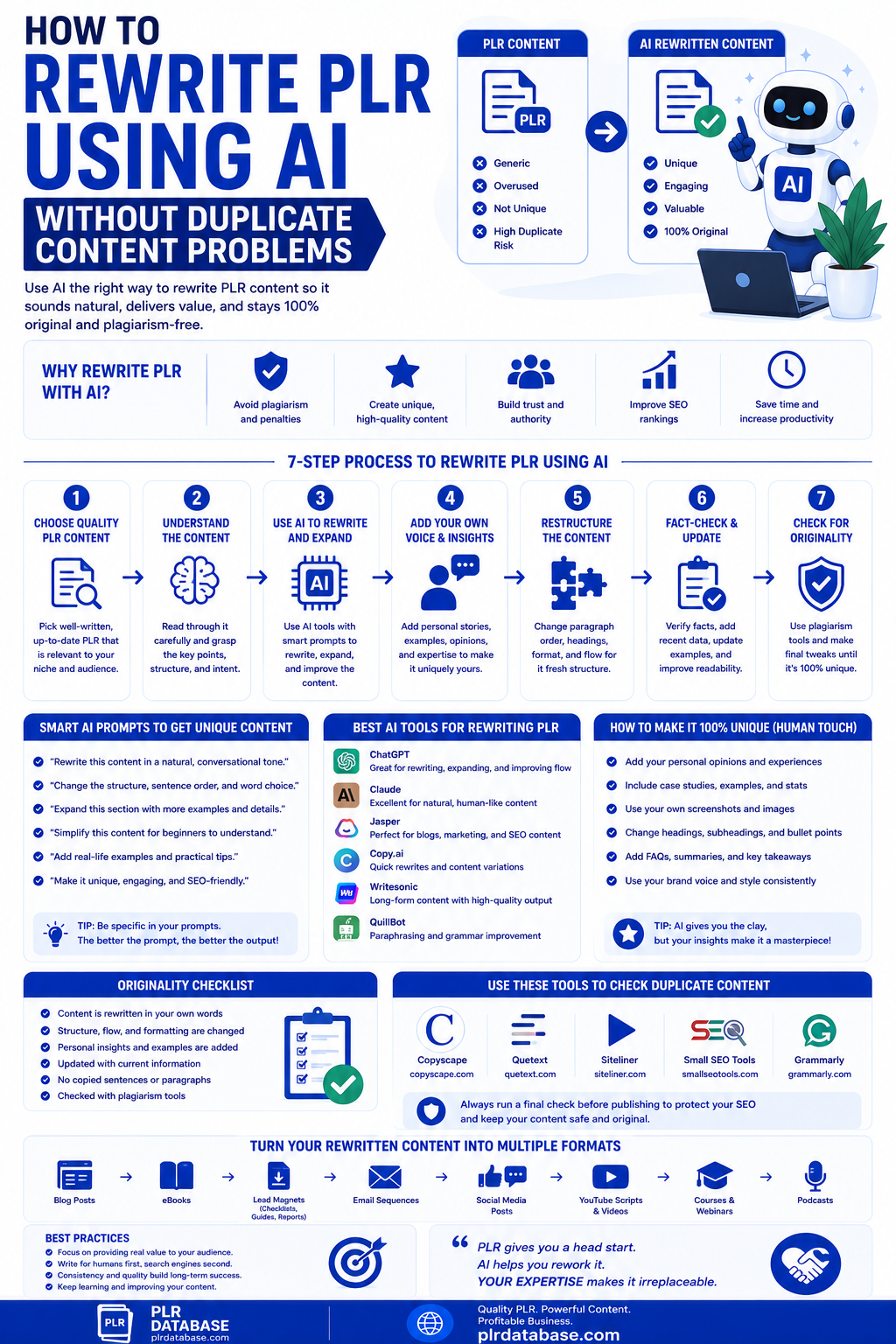
This article will teach you a rigorous, step-by-step system to strip a PLR asset down to its skeletal structure and rebuild it into a high-value, original masterpiece.
Whether you are building a niche blog or a premium digital product, you are about to learn how to turn recycled words into unique digital gold.
In This Article
The Death of Spinning and the Rise of Semantic Uniqueness
In the early days of SEO, "spinning" was the weapon of choice. You would take a PLR article, run it through software that swapped out synonyms, and call it a day. But in 2026, search algorithms don't just look at the words; they look at the underlying concepts and the "fingerprint" of the writing.
Traditional spinning software creates text that is technically unique to a plagiarism checker but semantically identical to the source. AI search engines now recognize these patterns instantly.
If your content provides the exact same information in the exact same order as a thousand other sites, it offers zero incremental value, and you will be buried in the search results.
To thrive today, you must aim for semantic uniqueness. This means changing the structure, the depth, and the perspective of the information provided. PLR should be treated as a research brief rather than a finished script.
The goal is to use the PLR to understand the core "what" of a topic, while using AI to redefine the "how" and "why."
When you approach rewriting from this angle, you aren't just avoiding a duplicate content penalty; you are creating a superior product. You are taking a generic base and layering it with updated statistics, better analogies, and a more compelling narrative voice that speaks directly to your specific audience.
This shift in strategy also changes your economic outlook. When you stop being a "content reseller" and start being a "content architect," your profit margins skyrocket.
A generic PLR ebook might sell for $7, but a uniquely reconstructed, AI-enhanced authority guide on the same topic can easily command $47 or more.
The "duplicate content problem" is actually a filter that removes low-effort competitors from the marketplace.
By mastering the AI-driven rewrite, you aren't just surviving the algorithm; you are leveraging it to prove your authority and dominate your niche.
The Structural Deconstruction Phase: Breaking the PLR Mold
The first step in our system is to destroy the original organization of the PLR. Most PLR is written in a very predictable, linear fashion. If you leave that structure intact, the AI will naturally follow the same flow, leading to a "ghost" of the original content. To break this, you must perform a structural deconstruction.
Start by feeding the entire PLR asset into your AI and asking it to extract only the "Hard Facts and Core Concepts." Instruct the AI to ignore the adjectives, the transitions, and the fluff.
What you want is a clean list of the raw information that makes the content valuable in the first place.
Once you have this list of "data points," you must create a new "Logical Architecture." Don't look at how the original author organized the chapters. Instead, ask the AI to suggest three alternative ways to structure this information for a specific target audience.
For example, if you have a PLR ebook on "Remote Work Productivity," the original might be organized by "Tools, Habits, and Environment."
You could restructure it as a "30-Day Transition Roadmap" or a "Manager’s Guide to Virtual Teams." By changing the intended outcome, you ensure the resulting text has a completely different structural fingerprint.
Realistic implementation involves a "Shuffle and Expand" technique. Take the extracted data points and deliberately move them into different sections of your new outline.
If a piece of information was in the introduction of the PLR, see if it fits better as a deep-dive case study in your third chapter.
This manual intervention prevents the AI from falling into the "rhythm" of the original text.
You are providing the AI with the ingredients, but you are dictating a completely new recipe. This is the only way to guarantee that your final product feels like a ground-up creation rather than a superficial makeover.
The Core AI Transformation System: Rebuilding From the Ground Up
With your new architecture and raw data points ready, it is time to engage the transformation engine. This is where most people fail because they give the AI too much freedom. You should never say "rewrite this." Instead, use a "Persona-Driven Synthesis" prompt.
Define a high-level expert persona... such as a "Skeptical Data Scientist" or a "Direct-Response Copywriter with 20 Years Experience, " and tell the AI to write the content using only the data points you provided.
This forces the AI to generate entirely new prose, sentences, and transitions that reflect the chosen persona's unique vocabulary and syntax.
During the writing phase, you must employ "Contextual Injection." This means asking the AI to add "why it matters" to every "what is it." For example, if your PLR data point says "Use a Pomodoro timer for focus," your AI should expand this by explaining the neurological benefit of task-switching.
This adds "meat" to the bones of the PLR. You are using the AI to do the heavy lifting of expansion and explanation, which naturally dilutes the original PLR content until it is unrecognizable.
By the time the AI is done, the core value remains, but the delivery is entirely fresh and tailored to your specific brand.
Finally, you must use a "Multi-Pass Refinement" process. Never settle for the first draft the AI gives you. Once a section is written, tell the AI to critique it for generic language and replace it with punchy, high-impact metaphors.
Ask it to find points where it sounds like a standard AI output and rewrite them to be more conversational and opinionated. This "polishing" pass is what removes the "robotic" feel that often triggers AI detectors and search engine red flags.
You are aiming for a final result that feels like it was written by a human expert who happened to use a very good research brief.
Injecting Human Experience and Real-World Data Loops
In 2026, the biggest differentiator between "spam" and "authority" is the presence of personal experience and live data. PLR is inherently "static," it is a snapshot of information from the time it was written. To make it truly unique and rankable, you must inject "Human Experience Loops."
This means taking the AI-generated text and manually adding personal anecdotes, localized examples, or "contrarian" opinions that weren't in the original PLR.
If the PLR says "Email marketing is good," you should add a section about why you think most email marketing is actually annoying, and how to do it differently.
Furthermore, you must utilize "Real-World Data Loops." PLR is often filled with outdated statistics or vague claims. You should use AI tools with live-search capabilities to replace every generic claim in the PLR with a 2026 citation.
For instance, if the PLR says "Many people are moving to the suburbs," you should update that to specific 2025 or 2026 Census Bureau data regarding "reverse-migration" trends.
This specific, timely data is something that the original PLR (and your competitors who are just lazily rewriting it) will never have. This builds immense trust with both the reader and the search algorithm.
This injection process creates "Information Gain." Search engines are now specifically designed to reward content that adds new information to the web rather than just repeating what is already there.
By adding your own "take," your own data, and your own examples, you are providing a reason for the search engine to rank you above the original source.
You aren't just avoiding duplicate content; you are creating "superior content." This is the hallmark of a strategist who understands that persuasion requires more than just correct information... it requires a unique and authoritative perspective that can't be found elsewhere.
Optimizing for AI Search Engines and Modern Readability
Once your content is structurally and semantically unique, you must optimize it for the "AI Overviews" and conversational search queries that dominate 2026. Modern SEO isn't about repeating a keyword ten times; it is about "Entity Relationship Mapping."
You want to make sure your content clearly explains the relationships between different concepts. Use your AI to generate "Semantic Headers, " H2s and H3s that actually answer the questions people are asking their AI assistants.
Instead of a header like "Benefits of AI," use "How Generative AI Reduces Content Production Costs for Small Agencies."
Readability is the other half of the coin. In an era of infinite content, people skim. If your rewritten PLR looks like a giant wall of text, your bounce rate will be astronomical.
Instruct your AI to follow a "Mobile-First Prose" style.
This means short paragraphs (no more than 3-4 lines), the use of bolding for key takeaways, and the integration of "Pattern Interrupts" like pull-quotes or data tables.
Every section should be designed to give the reader a "win" within 30 seconds of reading. This keeps them on the page longer, which sends a powerful quality signal to search engines.
Finally, you must optimize for "Answer Engine Optimization" (AEO). AI search engines look for clear, concise summaries they can pull into their chat interfaces. At the end of each major section, include a "Key Takeaway" paragraph that summarizes the section in 2-3 sentences.
This increases the chances of your site being cited as the source for an AI's answer.
By doing this, you aren't just ranking for a keyword; you are becoming part of the "knowledge graph" that the AI uses to inform its users. This is the highest form of SEO in the current age and essential for long-term traffic.
The Essential AI Toolkit for 2026 Content Creators
To execute this system at scale, you need a specialized stack of tools that go beyond the basic chatbot interface. Your "Primary Architect" should be a high-reasoning model which excels at understanding complex instructions and maintaining a consistent brand voice.
These are the tools you use for the initial deconstruction and the persona-driven synthesis.
However, you also need a "Fact-Checking Specialist," an AI tool with real-time browsing capabilities to handle the modernization of your data and statistics. This dual-model approach ensures your content is both creatively fresh and factually bulletproof.
For the final "Unique Polish," you should utilize style-enhancement tools. These are AI models specifically trained on high-converting copywriting or journalistic standards.
They can take a "technically correct" draft and inject the rhythmic variation and emotional resonance that makes writing truly engaging.
Additionally, you should always run your final output through a "Semantic Similarity Checker." These are the 2026 versions of plagiarism checkers; they compare your text to existing content on the web to ensure that your structural and conceptual fingerprint is sufficiently different from the source PLR.
Finally, don't overlook "Visual AI" tools. To truly move away from the "duplicate content" feel, your article needs original imagery.
Use AI image generators to create custom infographics, header images, and diagrams that are specific to your new structure.
A piece of content that has a unique text fingerprint and unique visual assets is almost impossible for a search engine to flag as unoriginal. This toolkit allows you to act as a one-person media house, producing high-authority, 2,000-word guides that feel like they were produced by an entire team of professionals.
Five Fatal Mistakes That Lead to Duplicate Content Penalties
The first and most common mistake is failing to change the "Niche Angle." If you buy a PLR article about "Yoga for Beginners" and you rewrite it as "Yoga for Beginners," you are still competing in the same crowded space with the same core ideas.
The solution is to use the AI to "Pivot" the niche. Rewrite that PLR as "Yoga for Desk-Bound Software Engineers" or "Yoga for Combat Sports Recovery." By changing the angle, you naturally change the vocabulary, the examples, and the structure, making duplicate content problems a mathematical impossibility.
The second mistake is over-reliance on "One-Click Rewriters." There are many tools that promise to make your content unique with one click. These tools usually just engage in sophisticated synonym swapping.
While they might pass an old plagiarism checker, they fail the 2026 "Semantic Value" test. If the AI doesn't understand the meaning of what it is writing, it will produce "word salad" that search engines identify as low-quality AI spam. Never skip the deconstruction phase; it is the only way to ensure the AI is building something truly new.
Third is forgetting to "Clean" the PLR source. Many PLR files come with hidden metadata, specific formatting quirks, or even "fingerprinted" sentences that the original author inserted to track their work.
If you feed these directly into an AI, the AI might inadvertently carry over these markers. Always "strip" your PLR to plain text before processing.
More importantly, check for specific metaphors that are unique to that PLR author... and tell your AI to explicitly avoid them. This ensures there are no lingering DNA traces of the original work in your final product.
Fourth, many creators ignore the "Introduction and Conclusion" sections. They spend all their time rewriting the body but leave the intro and outro relatively similar to the original. This is a massive red flag.
Search engines often weigh the beginning and end of a document more heavily when determining its "essence." You should always write your introduction and conclusion from scratch.
These sections should reflect your unique brand voice and your specific call to action, which the original PLR could never provide anyway.
Finally, the mistake of "Passive Fact-Checking" can kill your authority. If the PLR contains a factual error and you simply rewrite that error in a new voice, you are still publishing misinformation. Search engines are increasingly sophisticated at "Fact-Matching."
If you publish a claim that has been debunked or is clearly outdated, your entire site's trust score will plummet. In the age of AI, accuracy is a ranking factor. Use your AI to aggressively challenge every claim in the PLR. If the AI can't find a 2025 or 2026 citation for a claim, delete it or update it immediately.
Conclusion and Your 48-Hour Content Launch Plan
The secret to success with PLR in 2026 is to stop treating it as a product and start treating it as a raw ingredient. When you apply the system of deconstruction, persona-driven synthesis, and contextual injection, you are doing more than just avoiding "duplicate content."
You are building a sustainable competitive advantage. You are using technology to produce high-end, original content at a speed that was previously impossible.
This is the ultimate "power move" for direct-response marketers: combining the efficiency of AI with the strategic foundation of PLR to own your niche and dominate search.
Your action plan starts now:
Hour 1-4: Select a high-quality PLR asset and perform a "Hard Fact Extraction."
Hour 5-12: Design your new Logical Architecture and choose your expert persona.
Hour 13-24: Run your "Multi-Pass AI Transformation," focusing on one section at a time to maintain quality.
Hour 25-36: Perform your "Human Experience and Data Injection," add your own take and update every statistic to 2026.
Hour 37-48: Optimize for AI search engines, add your custom AI visuals, and hit publish. In two days, you will have a 2,000-word authority asset that ranks, converts, and builds your brand. The blank page is a relic of the past; your future is built on AI-driven reconstruction.
About the Author









0 Comments
Start The Conversation