
 Daniel Taylor
The digital landscape in 2026 has exposed a massive rift between lazy marketers and strategic creators.
For decades, PLR content was purchased under the premise of saving time, but the reality has become a branding disaster.
Thousands of buyers download the exact same text packs, upload them to their websites with zero customization, and then wonder why their traffic drops to nothing.
The problem is that traditional PLR lacks an identity. It is written to be broad, generic, and sterile so that it can apply to anyone.
Unfortunately, when content applies to everyone, it appeals to no one. Modern AI search engines recognize this lack of original depth instantly and will happily ignore your site because of it.
Simply changing a few sentences or swapping out the cover graphics will no longer cut it.
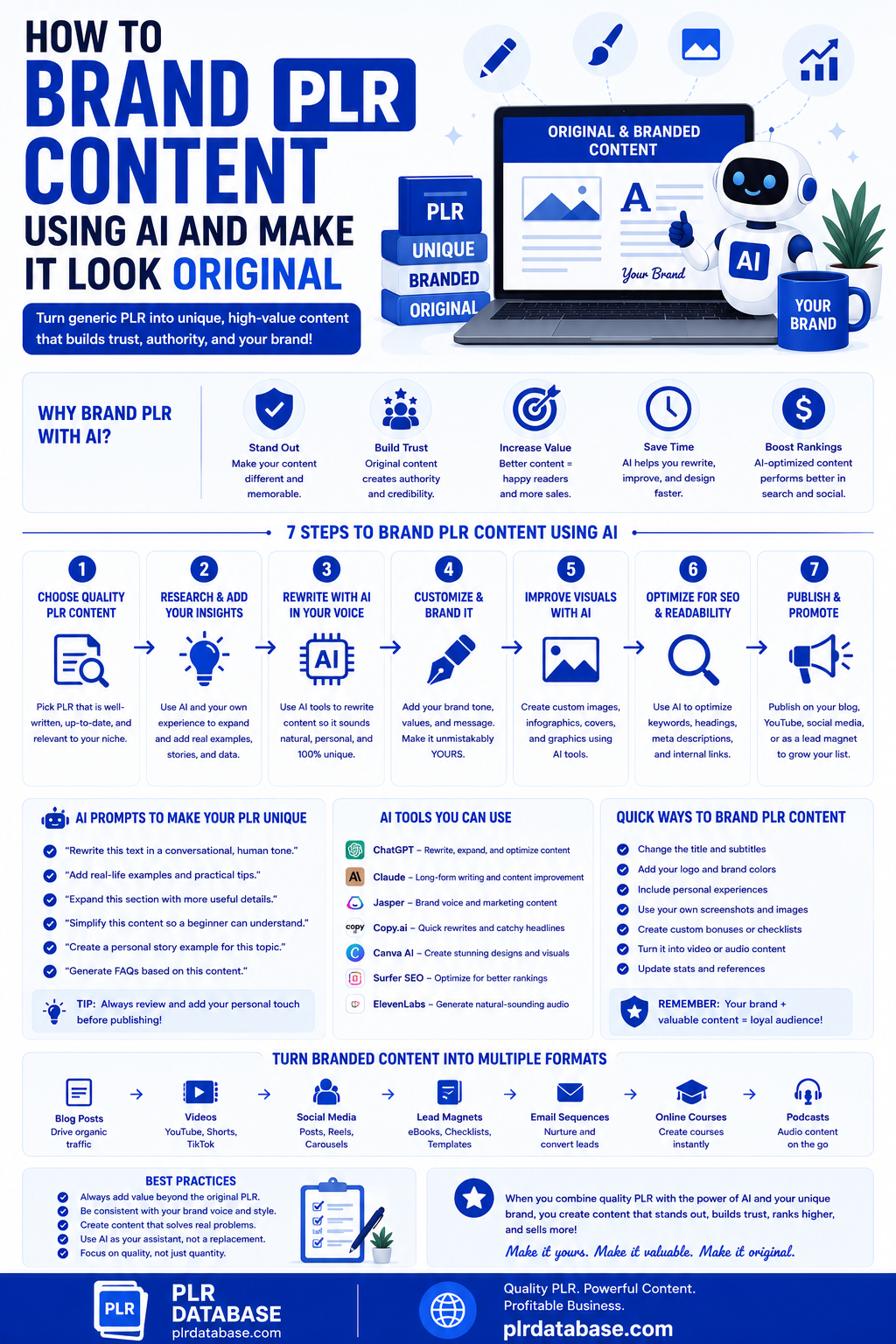
To survive and thrive in today's hyper-competitive feeds, you must learn how to completely rewrite the DNA of your licensed material. This article teaches you a practical, high-converting system to brand PLR assets using generative AI.
We will step past basic rewrites and dive deep into creating a custom brand voice print, updating factual relevancy, and engineering bespoke visual assets.
By the end of this guide, you will know how to turn a cheap, uninspired PLR license into a premium, distinct digital asset that commands audience trust and maximizes backend conversions.
In This Article
The Core Philosophy of Semantic Rebranding in 2026
To understand how to successfully brand licensed materials today, you must abandon the legacy mindset of text spinning. Old-school spinning software focused on tokens and software exclusively on replacing individual words with synonyms.
This lazy approach always resulted in clunky, unreadable text that was still structurally identical to the source.
Modern search engine algorithms do not evaluate content word-by-word anymore. Instead, they analyze semantic relationships, contextual frameworks, and overall information gain.
If your content presents the exact same arguments in the exact same sequence as twenty other sites, it provides no incremental value to the web ecosystem. It is dead on arrival.
Semantic rebranding means using AI to extract the raw data points of your PLR and reconstructing them inside an entirely new narrative framework. Think of your purchased PLR pack as a bucket of raw building materials.
Your job isn't to resell the bucket; your job is to use those materials to construct a unique building that reflects your specific brand values.
This approach eliminates the threat of duplicate content penalties while drastically increasing the perceived premium value of your offer.
A generic PLR guide on personal finance might only sell for a few dollars, but a beautifully branded, AI-synthesized financial roadmap tailored to freelance creators can easily pull premium prices.
Furthermore, branding with AI allows you to bridge the gap between static information and dynamic customer relationships. Modern buyers do not connect with faceless data; they connect with perspectives, opinions, and shared experiences.
When you inject a defined brand identity into a sterile PLR outline, you are giving the content a distinct pulse. This transformation is what turns casual search engine clickers into lifelong email subscribers.
You are shifting your positioning from a commodity distributor to a trusted niche authority, and that shift is entirely enabled by how intelligently you train your AI tools to re-engineer your source material.
Step 1: Engineering Your AI Brand Voice Print
The absolute baseline of making PLR content look completely original is establishing a rigid linguistic constraint for your AI, which we call a Brand Voice Print.
Most marketers log into a large language model, upload a PLR text file, and type a generic prompt like "rewrite this article to sound professional."
This lazy approach triggers the AI to fall back on its default, overly sanitized corporate prose. You end up with text peppered with tired clichés like "in today's fast-paced digital world" or "let's dive deep."
To break this cycle, you must build a highly descriptive persona blueprint that dictates exactly how the AI must handle sentence structures, emotional tone, and specific vocabulary choices.
To construct an effective Voice Print, you should provide your AI with a combination of structural rules and concrete stylistic examples.
For instance, you can instruct the model to write from the perspective of a direct-response marketer who values data brevity, avoids passive voice at all costs, and maintains a conversational yet highly authoritative tone.
You can explicitly command the AI to limit paragraph lengths to a maximum of three lines to optimize for mobile scannability, and to use vivid analogies instead of abstract industry jargon.
By defining these parameters before processing your PLR text, you force the model to completely dissolve the old author's stylistic footprint.
A realistic example of this system in action involves taking a dry PLR article about organic gardening and running it through a highly specialized Voice Print prompt.
If your target brand identity is punchy, rebellious, and counter-intuitive, the AI will naturally transform a sentence like "regular watering is essential for healthy plant growth" into something far more engaging.
The AI might rewrite it to say: "if you are still watering your garden on a rigid daily schedule, you are quietly drowning your root systems and killing your yield."
The foundational information remains identical, but the execution feels completely original, human, and tailored to a modern audience that craves authenticity over generic textbook advice.
Step 2: Structural Renovation and Fact-Layer Update
Once you have your brand voice locked down, you must address the physical structure of the PLR package. Most PLR is organized in a highly linear, predictable manner that feels incredibly dated to modern consumers. To fix this, you must run your text through a structural renovation phase.
Feed the PLR into your high-reasoning AI model and command it to strip away all transitions, intro paragraphs, and concluding fluff. Your goal here is to extract a bare-bones fact sheet of the core principles.
Once you have this list of raw concepts, instruct the AI to reorder the sequence based on a completely different logical angle, such as a 30-day transformation roadmap or a step-by-step diagnostic framework.
The second half of structural renovation is executing a rigorous fact-layer update.
PLR often sits in digital storefront warehouses for years before you purchase it, meaning the statistics, tool recommendations, and market data inside are completely obsolete.
You must deploy a search-enabled AI model to scan your raw fact sheet and challenge every date, claim, and data point. If the PLR mentions a specific industry standard from a few years ago, instruct your AI to search for current 2026 data to replace it.
Inserting phrases like "according to recent market evaluations published in Q1 of 2026" instantly signals to both human readers and search crawlers that your content is cutting-edge.
For example, if you are rebranding an old digital marketing PLR book, the original text might suggest building generic Facebook tracking loops.
Your AI modernization pass will automatically replace that advice with modern privacy-first server-side conversion tracking and predictive AI audience segments.
By shifting the context of the advice to reflect today's realities, you are providing genuine information gain to the internet.
You have taken a piece of historical content, stripped away its architectural rust, and rebuilt it into a highly accurate, current resource that earns backlinks, builds trust, and positions you as a true expert in your field.
Step 3: Creating a Unified Visual Ecosystem with AI
Branding goes far deeper than the written word; your visual presentation must match the premium quality of your newly synthesized text.
A fatal flaw committed by amateur PLR flippers is taking a beautifully rewritten article and pairing it with a generic, pixelated stock photo or a low-budget ebook cover template that came with the original PLR purchase.
This creates immediate cognitive dissonance for the visitor, signaling that the product is cheap and untrustworthy.
In 2026, you must leverage advanced generative image models to construct a proprietary visual ecosystem that belongs exclusively to your brand.
To execute this, use an image model to establish a specific style guide for all your graphic elements. Do not just prompt the machine for random images.
Instead, define a strict visual aesthetic, such as a moody neon cyberpunk color palette or a clean corporate flat-illustration style using specific hex codes.
Instruct the AI to generate cohesive product mockups, customized chapter headers, and stylized concept diagrams that visually represent the specific arguments in your text.
If your article describes a five-step sales funnel, have the AI generate an intricate, branded infographic that outlines that exact process using your exact color scheme.
When you display your content inside a unified visual frame, the perceived value of your asset skyrockets.
A consumer reading your blog post on a mobile device or scrolling through your product sales page will recognize a clean, intentional design language that flows seamlessly from header to footer.
This aesthetic polish allows you to take evergreen ideas found in affordable PLR licenses and repackage them into premium masterclasses, highly clickable lead magnets, or authoritative industry whitepapers.
Visual originality protects your brand reputation and ensures your final product looks like a ground-up corporate creation rather than a recycled digital file.
Practical Tools and Real-World Use Cases for Rebranding
Executing this comprehensive rebranding system requires a specialized assembly line of modern AI tools. For the initial deconstruction and high-level reasoning tasks, you need a deep-thinking model like Gemini 3 Flash to isolate the core knowledge graphs from long-form PLR texts.
When you shift into the voice print generation and stylistic polishing phase, you can couple the model with style-checkers to ensure all paragraph lengths, pacing variations, and conversational hooks are perfectly optimized for on-screen reading.
For real-time data verification, search-enabled AI tools are essential for keeping your statistics grounded in the present year.
Let us look at a real-world use case in the highly profitable weight loss and wellness niche. Imagine you purchase a generic PLR package entitled The Ultimate Guide to Keto.
Instead of launching another boring low-carb blog that gets buried under a million search results, you decide to use AI to pivot the niche angle completely.
You instruct your AI engine to merge the core nutritional concepts of the keto PLR with specific lifestyle data for night-shift healthcare workers.
The AI instantly filters out generic lifestyle advice and recalibrates the meal planning tips, chronological fasting windows, and energy management steps to fit a chaotic nighttime hospital schedule.
To complete this real-world pivot, you use your visual AI engine to generate custom minimalist infographics detailing meal-prep layouts specifically for hospital breakrooms.
You have successfully taken a broad, commoditized piece of text and transformed it into a hyper-targeted, premium solution for a highly specific sub-culture.
When a night-shift nurse lands on your content or your digital product storefront, they will feel an immediate, deeply personal connection to the copy because it speaks directly to their exact life constraints.
That level of hyper-targeted relevance is how you drive high conversion rates and generate massive profits from a simple, recycled asset.
Five Fatal Mistakes That Destroy PLR Originality
The first mistake is relying on a single-pass prompt. Many marketers assume that uploading a PLR article to an AI and typing "change the wording of this" is enough to create an original piece of content.
This lazy approach produces a superficial rewrite that retains the exact same paragraph structures, sequential logic, and conceptual pacing as the source text.
Search engine crawlers can easily see through this cosmetic makeover. You must always use a multi-pass approach: first extract the raw facts, then reorder the outline, and finally write the new copy from scratch using your brand persona.
The second mistake is allowing corporate AI jargon to leak into the final copy. If your rebranded PLR article is filled with words like "leverage," "optimize," "testaments," or "meticulously crafted," your readers will instantly flag it as uninspired machine output.
These specific linguistic habits destroy the human trust connection required to make a direct-response funnel profitable.
You must implement a strict negative prompt parameter within your AI workflow that explicitly forbids the use of over-saturated machine vocabulary, forcing the tool to use conversational, natural human styling.
The third mistake is failing to execute an independent fact-check. When you buy a PLR bundle, you have no idea if the original ghostwriter pulled their statistics from a legitimate source or simply made them up to fill space.
If you allow your AI to rewrite a factual error without verifying the underlying claim, you are actively spreading misinformation under your own name.
This error can permanently destroy your domain authority and brand trust. You must treat your AI tool as a strict research editor that challenges every single metric presented in the original text file before publishing.
The fourth mistake is omitting personal bias and contrarian opinions. Raw PLR is written to be incredibly safe and non-controversial so that it can be sold to thousands of different people without causing offense.
However, safe content is incredibly boring to read and fails to convert casual traffic into active buyers.
When branding with AI, you must explicitly instruct the model to inject your specific viewpoint or a contrarian take on the industry standard. If the PLR states a conventional rule, use your AI to explain why that rule is broken, obsolete, or flat-out wrong for your specific audience segment.
The fifth mistake is ignoring platform-specific content formatting. A long-form blog post cannot be dropped directly into an email newsletter or a social media carousel without undergoing a complete structural translation.
Trying to save time by forcing one style of output across all your digital marketing channels creates an unnatural user experience.
You must use your AI stack to atomize your core branded asset, re-engineering the hooks, formatting layouts, and call-to-action triggers to match the native consumption behavior of each individual platform you target.
The 2026 Action Plan: Your Blueprint for Brand Dominance
Transforming raw Private Label Rights licenses into high-value, totally unique digital assets is an exercise in strategic execution. In the modern content landscape, the winners are those who can synthesize information with extreme speed while maintaining an undeniable human edge.
By leveraging the modular AI system of deconstruction, voice print styling, and visual synchronization outlined in this guide, you can comfortably out-produce your competitors while building an authoritative digital footprint that lasts.
Your 72-Hour Execution Plan:
- Phase 1 (Hour 1 to 12): Audit your current digital asset library or purchase a high-quality evergreen PLR package. Create your Brand Voice Print document, outlining your specific tone, target demographic, paragraph formatting limits, and banned phrases.
- Phase 2 (Hour 13 to 36): Run your PLR source text through your AI Extraction module to pull out raw conceptual facts. Run these facts through a live-search AI tool to update all numbers, strategies, and industry references to clear 2026 standards.
- Phase 3 (Hour 37 to 60): Reconstruct the text using your Persona-Driven prompt pass. Inject your personal anecdotes, contrarian positions, and specific niche pivots to ensure complete structural and semantic originality.
- Phase 4 (Hour 61 to 72): Deploy your generative visual AI suite to build a matching design ecosystem of ebook covers, infographics, and mobile-friendly section headers. Assemble your finished pieces, run a final editing pass, and push your premium asset live.
By executing this disciplined framework, you cease to be a passive reseller of generic digital text. You become a high-speed content architect, using advanced technology to maximize your efficiency while building a distinct, authoritative brand identity that commands long-term audience monetization.
The blank page is no longer your problem; it is time to build your empire.
About the Author








0 Comments
Start The Conversation