
 Daniel Taylor
The digital economy of 2026 has officially moved past the era of manual labor. For years, Private Label Rights (PLR) content was marketed as the ultimate shortcut, yet most buyers found themselves buried under a mountain of generic files that still required hours of massaging to become usable.
The problem isn't the PLR itself; it is the friction of the human bottleneck.
If you are still manually copying, pasting, and rewriting articles, you aren't running a business... you are performing administrative chores. In a world where AI search engines prioritize semantic depth and fresh data, the buy and post model is dead. To survive and thrive, you must shift your focus toward building an automated refinery that takes raw information and turns it into high-value authority assets on autopilot.
This article provides the definitive blueprint for constructing a content machine that leverages AI to process PLR material daily. We are moving beyond simple spinning and into the realm of intelligent automation.
You will learn how to architect a system that deconstructs PLR, verifies facts against real-time 2026 data, injects a consistent brand persona, and distributes multi-platform assets without you having to touch a single key. It is time to stop working for your content and start making your content work for you.
In This Article
The 2026 Content Landscape: Why Automation is Survival
In the current digital ecosystem, the sheer volume of content being produced by generative AI has created a signal-to-noise crisis. For a marketer using PLR, this presents a unique challenge: search engines like Google and Perplexity have become incredibly adept at identifying low-effort content. If your automated machine simply churns out slightly reworded versions of a ten-year-old PLR article, you will be penalized by the algorithms and ignored by your audience.
Success in 2026 requires Information Gain... the ability to add new insights, contemporary data, and a unique perspective to existing information. This is why automation is no longer a luxury; it is the only way to maintain the necessary frequency of high-quality output required to stay relevant in a hyper-competitive feed.
The shift toward Answer Engine Optimization (AEO) means that users are increasingly getting their information from AI assistants rather than scrolling through pages of links.
To be the source that these assistants cite, your content must be structured, factual, and authoritative. Manual creation simply cannot keep up with the speed of information decay. By the time you manually update a PLR ebook, the market has moved on.
Automation allows you to plug in your PLR library to a live data stream, ensuring that every piece of content published under your brand is current and accurate. This creates a compounding effect where your authority grows daily because you are consistently the first to provide modernized solutions to evergreen problems.
Furthermore, the economics of 2026 dictate that your Profit per Content Unit must be optimized. If you spend four hours editing a $5 PLR article, your ROI is negligible.
However, if your automated system refines that same article into a blog post, a YouTube script, and a series of social media threads in five minutes, your margins skyrocket. Building an automated machine allows you to scale horizontally across multiple niches.
You can run five authority sites in diverse markets... from sustainable biohacking to AI-native support SaaS... using the same underlying logic. Automation is the bridge between being a content creator and being a media mogul.
The Architecture of an AI-Native Content Refinery
Building a content machine requires a departure from the single-prompt mindset. You cannot simply tell an AI to rewrite this PLR article and expect a professional result. A true refinery is built on a modular architecture: Extraction, Modernization, Stylization, and Verification. The Extraction module takes your raw PLR file... whether it is a 50-page ebook or a 500-word article, and strips it down to its skeletal concepts.
It ignores the fluff and identifies the Core Truths. This prevents the AI from inheriting the generic, dated prose of the original author.
For example, if you are processing a PLR guide on email marketing, the refinery extracts the principles of segmentation and deliverability while discarding the outdated advice about 2015-era software.
The Modernization module is where the 2026 advantage kicks in. This part of your machine connects to the live web to find current statistics, recent case studies, and relevant news events that align with your extracted concepts.
If the PLR mentions the rise of social media, the Modernization module replaces that with the integration of generative agents in social commerce. This ensures your content feels of the moment. Following this, the Stylization module applies your brand's unique Voice Print.
This is a set of linguistic constraints... such as sentence length, tone, and specific vocabulary, that makes the content indistinguishable from your own writing. This is the stage that builds the trust required for conversion.
Finally, the Verification module acts as your digital editor-in-chief. It runs the polished content through a series of checks: Does it pass 2026 semantic uniqueness tests? Is the data accurate? Does the Call to Action (CTA) align with the product being promoted?
By structuring your machine in these distinct stages, you eliminate the hallucination problems common with basic AI usage.
You aren't just generating text; you are manufacturing authority. Each module can be tweaked and improved over time, allowing your content machine to get smarter and more efficient the longer it runs.
Step-by-Step: Constructing Your Daily Automation Logic
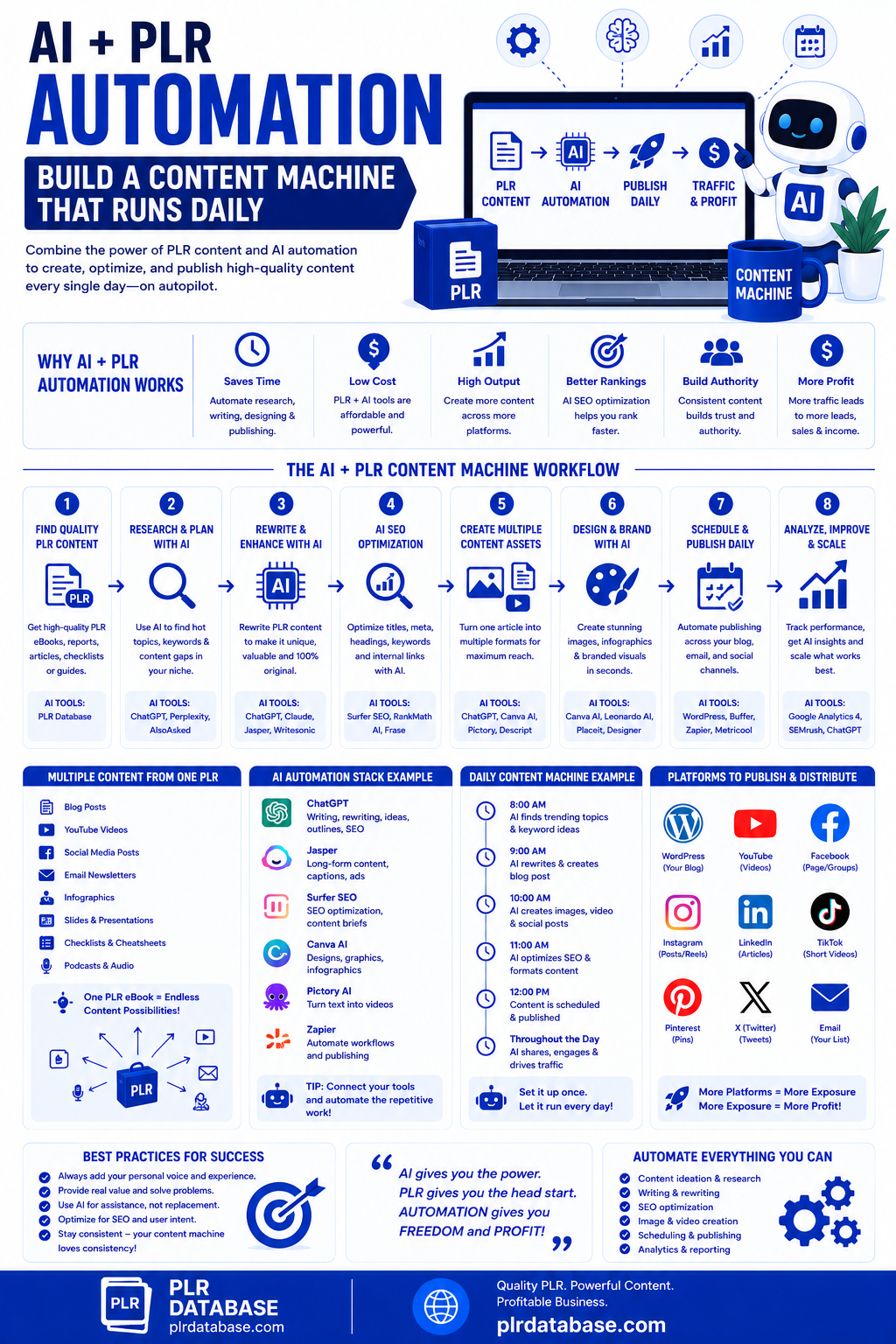
To build a machine that runs daily, you must create a logic flow that handles the transition from file on a drive to published post. The first step is setting up a Watcher trigger. Using tools like Zapier, Make, or a custom script, you create a folder in a cloud drive where you drop your raw PLR assets.
The moment a new file is detected, the machine triggers the Extraction module. For a daily machine, you might schedule this to run at 2:00 AM, so you wake up to a queue of refined drafts.
This trigger ensures that you don't have to manually prompt the system every time you want new content.
The second step involves Chaining your prompts. You feed the output of the Extraction module into a high-reasoning Large Language Model (LLM) with a specific instruction set for modernization.
For instance, you might use a prompt that says: Take these five core principles of lead generation and find three 2026 data points from reputable marketing journals that support or update these claims.
This creates a Knowledge Asset that is significantly more valuable than the original PLR. The logic here is cumulative; each step in the chain adds a layer of value that separates your output from the thousands of other marketers who bought the same PLR package.
The final step in the daily logic is the Format Atomization phase. One PLR article should never just be one blog post.
Your machine should be programmed to take the refined Knowledge Asset and generate multiple formats: a 1,200-word deep-dive article, a 60-second video script for TikTok, and a 10-post thread for X.
By automating the atomization of the content, you ensure that your brand is omnipresent across the platforms where your audience actually lives. The beauty of this daily logic is its consistency. While your competitors are struggling to find time to write one post a week, your machine is populating a multi-channel ecosystem every single day while you focus on higher-level strategy.
This isn't just about speed; it's about staying top-of-mind without burning out.
Injecting Authority: Moving Beyond Generic AI Rewrites
The primary reason most content automation fails is that it sounds AI-ish. In 2026, the average reader can spot a default AI tone within the first two sentences. To build a machine that converts, you must solve the Anonymity Problem. This is done through Contextual Injection.
Instead of just asking the AI to write about a topic, you must feed your machine a Brand Bible that contains your personal stories, your contrarian opinions on the industry, and your specific methodology.
For example, if you are an expert in WordPress development, your machine should be instructed to Always frame technical advice through the lens of user-experience and security-first development. Another powerful way to inject authority is through Dynamic Social Proof.
Your machine should be connected to your customer feedback loop or your recent project results. When it processes a PLR article about customer retention, it should be able to pull a real-world example from your own business to illustrate a point.
This turns a generic article into a case study. Even if the underlying structure came from a $10 PLR pack, the specific application is 100% unique to you. This is the difference between a content bot and an automated expert.
Readers don't just want information; they want to know how you solved a problem. Finally, you must use Strategic Contrarianism. Tell your machine to identify the most common cliché advice in the PLR and offer a counter-argument.
If the PLR says The customer is always right, your machine might rewrite that section to discuss Why firing bad clients is the secret to 2026 agency growth. This creates Pattern Interrupts in your content that stop the scroll and force the reader to engage.
By programming your AI to be opinionated, you create a brand that people actually want to follow. Authority is not found in agreement; it is found in the confidence to offer a better way.
The Multi-Channel Distribution Engine
The true power of an automated PLR machine is realized when the content leaves your website. In 2026, your blog is just the Source of Truth, but your revenue is driven by the Distribution Orbs... social platforms, newsletters, and video feeds.
Your machine must be equipped with an Atomizer that takes your modernized article and reformats it for the specific psychology of each platform.
For example, the LinkedIn version of your content should focus on professional ROI and networking, while the Instagram version focuses on visual storytelling and Behind the Scenes implementation.
This isn't just about changing the length of the text; it is about changing the angle of the value proposition. Automation allows you to schedule this distribution in a Waterfall sequence. On Monday, your machine publishes the deep-dive article on your site.
On Tuesday, it pulls three Power Quotes from that article and posts them as high-engagement social updates. On Wednesday, it takes the Core Problem discussed and sends out a personalized email to your subscribers with a direct link to a product.
This creates a multi-touchpoint journey for your audience that feels manual and thoughtful but is actually entirely pre-programmed. This Echo Chamber effect makes your brand feel much larger than it is, building the omnipresence required to dominate a niche.
Furthermore, your distribution engine should include an Engagement Trigger. Modern AI tools can monitor the comments on your automated posts and alert you to high-intent questions.
Some advanced systems can even generate First Pass responses based on your Brand Bible, which you can then approve or edit.
This turns your content machine into a community-building tool. When people see that you are active and responding to their needs, their trust in your brand skyrockets.
You are using the efficiency of AI to handle the volume, which frees up your human time to handle the high-value personal connections that lead to high-ticket sales.
The 2026 Automation Stack: Essential Tools and Use Cases
To execute this daily content machine, you need a specialized stack of tools that prioritize Reasoning and Connectivity. For the core of your refinery, you need a high-end LLM with a large context window, such as Gemini 3 Flash.
These models are capable of processing long PLR ebooks in a single pass without losing the thread of the argument. For the Connectivity layer, platforms like Make.com are superior to basic tools because they allow for complex branching logic... if the content is about Strategy, send it to LinkedIn; if it is about Tutorials, send it to YouTube and your blog.
For the Modernization module, you need an AI tool with Deep Search capabilities to provide the 2026 Fact Layer for your content. For visual assets, the 2026 standard is Generative Consistency.
Tools like Gemini 3 Flash Image allow you to generate images that maintain the same style, color palette, and character likeness across all your posts. This ensures your brand has a professional, "designed" look that distinguishes it from the millions of generic, mismatched AI images currently flooding the web.
A practical use case for this stack is the "Niche Authority Site." Imagine buying a 50-article PLR pack on "Smart Home Security." You drop the articles into a folder.
Your machine extracts the facts, updates them with the latest 2026 hardware reviews, writes the posts in a "Security Expert" voice, generates custom diagrams of home layouts, and schedules them for daily release over seven weeks.
In one afternoon of "machine building," you have created an authority site that would have previously required a team of writers and an editor. This is the ultimate application of the AI + PLR synergy: low-cost inputs refined into high-value digital real estate.
Five Fatal Mistakes in Content Automation
The first mistake is "Passive Fact-Checking." In 2026, publishing an outdated statistic is a death sentence for your authority. Many marketers assume that because the AI is "smart," it will automatically know if the PLR is wrong.
You must explicitly program a verification step into your machine that challenges the PLR's claims against current data. If your machine cites 2021 as "the current year," you have failed. Accuracy is the price of admission for ranking in AI search engines.
The second mistake is "Tone Drift." Without a strong Brand Bible and specific stylistic constraints, your machine will produce content that sounds like a different person wrote it every day. This prevents you from building a loyal audience. Consistency is a trust signal.
You must ensure that your Stylization module is rigid enough to maintain your voice across every platform. If your blog is formal but your social media is chaotic for no strategic reason, you will confuse your prospects.
Thirdly, many fail to "Humanize the Hook." While AI can write a great middle, it often struggles with the "Emotional Opening" that stops the scroll. A fatal mistake is letting the machine write generic headlines like "Understanding the Importance of XYZ."
You should use your machine to provide you with three "Angle Options," and then take 30 seconds to manually polish the one you like best. This "Human-in-the-Loop" approach for the first 100 words can increase your engagement by 500%.
The fourth mistake is "Format Neglect." Turning an article into a video script by just saying "read this aloud" doesn't work. Each format has its own "Grammar." A YouTube script needs "Pattern Interrupts" and "Visual Cues." A LinkedIn post needs "White Space" and a "Punchy Ending."
If your machine doesn't respect the grammar of the platform, the content will feel "uncanny" and users will ignore it. Automation must be intelligent enough to re-engineer the content, not just re-post it.
Finally, the "Set it and Forget it" Delusion. No automation machine is perfect forever. Algorithms change, brand voices evolve, and AI models get updated. The biggest mistake you can make is never auditing your own machine.
You should spend at least one hour a week reviewing the "Daily Output" and making small tweaks to your prompts or your logic flow.
Automation is a tool to amplify your strategy, not a replacement for it. If you lose touch with your machine, you lose touch with your audience.
Conclusion: Your 30-Day Automated Launch Plan
Building a daily content machine is the ultimate leverage for the modern direct-response marketer. You are no longer limited by the number of hours you can spend at a keyboard.
By using PLR as your foundation and AI as your refinery, you can produce a volume of high-quality, authoritative content that was once the exclusive domain of massive media corporations.
This system isn't just about saving time; it is about building an asset that grows in value and authority every single day. The technology is here, the data is accessible, and the opportunity is wide open for those willing to build the machine.
Your 30-Day Action Plan:
- Days 1-7: Audit your existing PLR library and identify one core niche. Define your "Brand Bible"... your voice, your opinions, and your stories.
- Days 8-14: Build your "Refinery Logic." Set up the Extraction and Modernization modules using Make.com and a high-reasoning LLM.
- Days 15-21: Connect your "Distribution Engine." Set up the logic to atomize your articles into social threads and email newsletters.
- Days 22-30: Run the machine in "Draft Mode." Review the daily output, refine your prompts, and ensure the Voice Print is consistent. On Day 30, flip the switch to "Live."
The era of manual content creation is a relic of the past. Your future is automated. Start building your machine today, and by this time next month, you will have a content presence that never sleeps, never gets tired, and never stops building your empire.
About the Author








0 Comments
Start The Conversation