
If you've been collecting PLR products for a while, there's a good chance you have dozens, or even hundreds, of valuable resources sitting on your hard drive.
Maybe they're ebooks, articles, videos, templates, checklists, or reports that you downloaded with great intentions but never got around to using.
The good news is that those products haven't lost their value. In fact, they may be worth more today than when you first downloaded them.
With a little creativity and the help of modern AI tools, you can transform old PLR products into fresh content that attracts traffic, grows your audience, and generates new income.
Instead of constantly creating everything from scratch, you can repurpose existing content into multiple formats that appeal to different audiences across different platforms.
Content repurposing isn't about copying and pasting old material. It's about taking valuable information and presenting it in new, useful ways.
Done properly, it saves time, improves your productivity, and helps you get far more value from every PLR product you own.
In this guide, I'll show you some of the best ways to breathe new life into your existing PLR content while keeping it relevant, engaging, and optimised for today's online audience.
In This Article
What Is Content Repurposing?
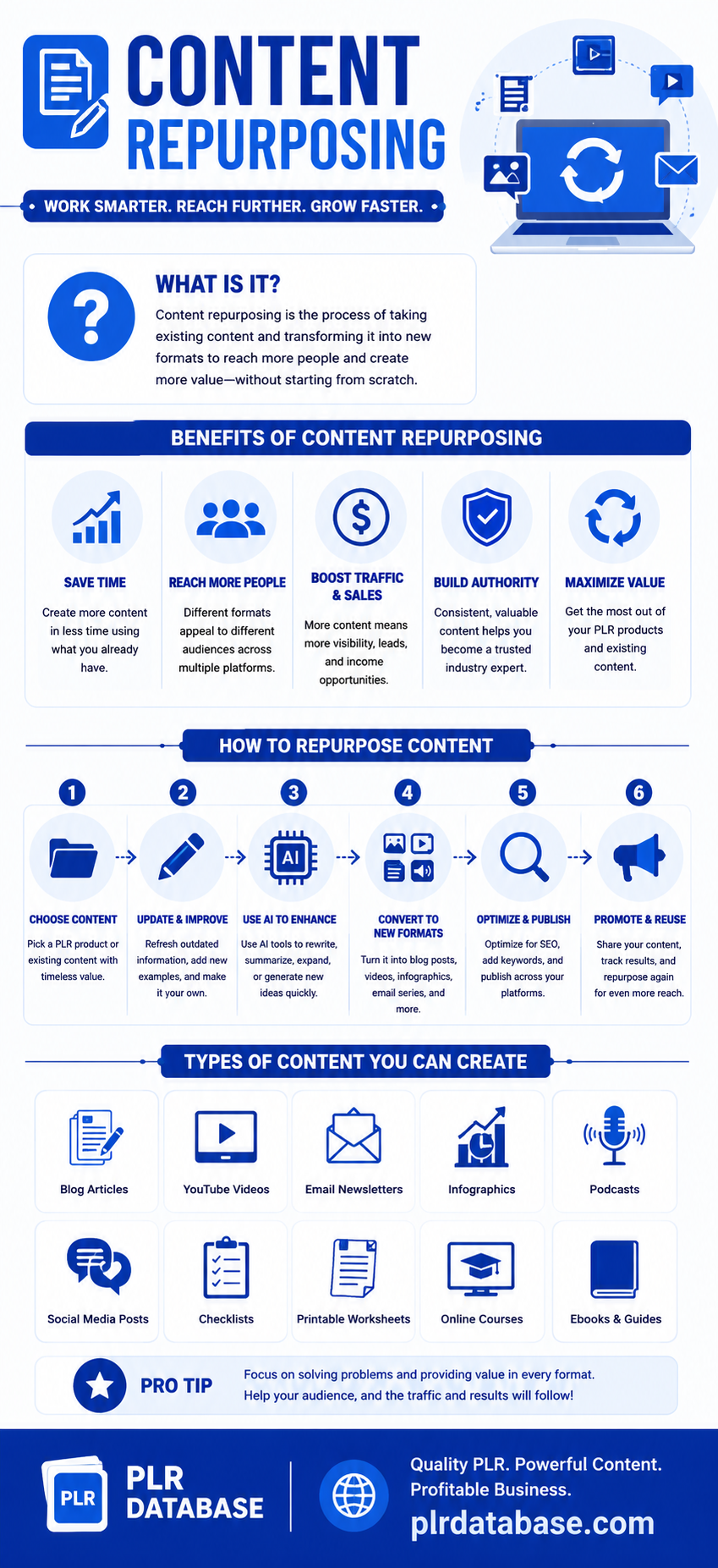
Content repurposing is the process of taking existing content and transforming it into new formats without having to start from scratch.
Instead of creating ten separate pieces of content, you create one valuable resource and then adapt it into multiple assets.
For example, a single PLR ebook could become:
- Blog articles.
- YouTube videos.
- Social media posts.
- Email newsletters.
- Infographics.
- Podcasts.
- Checklists.
- AI prompt packs.
- Printable worksheets.
- Online courses.
This approach allows you to reach different audiences while making the most of the work you've already done.
Repurposing is one of the smartest ways to build a large content library without constantly creating new material.
Why Repurposing PLR Content Makes Sense
Many people purchase PLR products, download them, and never look at them again.
That's a missed opportunity.
Most quality PLR products contain valuable information that can easily be updated and presented in fresh ways.
Instead of letting those files collect digital dust, treat them as the starting point for creating completely new resources.
Repurposing also saves time.
Rather than researching a topic from the beginning, you're working from an existing foundation that can be expanded, updated, and personalised.
This allows you to publish more content while maintaining quality.
Update Outdated Information
One of the first things I recommend doing is reviewing older PLR products for outdated information.
Technology changes quickly.
Marketing strategies evolve.
AI tools improve almost weekly.
Before republishing any content, check that everything is still accurate.
Update things like:
- Statistics.
- Website references.
- Software recommendations.
- Screenshots.
- Marketing strategies.
- Search engine advice.
- AI tools.
- Social media platforms.
Adding current information instantly makes older PLR products far more valuable.
Your readers will appreciate receiving advice that's relevant today rather than several years ago.
Rewrite Content in Your Own Voice
Even if the original PLR content is well written, I always recommend adding your own personality.
Readers connect with people, not generic writing.
Share your own experiences.
Include practical examples.
Explain what has worked for you.
Mention lessons you've learned along the way.
AI can also help rewrite content while maintaining a natural writing style.
However, always review the final version and make sure it sounds like you.
Your personality is one of the biggest things that separates your business from everyone else selling similar products.
Turn One Product Into Multiple Content Formats
One of my favourite content strategies is extracting as much value as possible from a single product.
Imagine you have one PLR ebook.
That ebook could easily become:
Blog Articles
Split each chapter into a separate SEO article.
YouTube Videos
Create tutorials covering each section.
Email Series
Send one lesson every few days.
Social Media Posts
Extract helpful tips and quotes.
Infographics
Present important information visually.
Podcasts
Discuss each chapter conversationally.
Checklists
Summarise important action steps.
Mini Courses
Expand the content into video lessons.
Instead of creating one product, you've now created an entire content ecosystem.
Use AI to Speed Up Repurposing
Artificial intelligence has completely transformed content repurposing.
Tasks that once took hours can now be completed much faster.
AI can help you:
Rewrite Articles
Create fresh versions while improving readability.
Expand Content
Turn short reports into comprehensive guides.
Generate Headlines
Create engaging SEO-friendly titles.
Create Social Media Content
Generate dozens of promotional posts.
Produce Video Scripts
Convert written content into YouTube videos.
Build Email Campaigns
Transform blog articles into newsletters.
Design Graphics
Generate illustrations and promotional images.
Research Keywords
Identify topics people are actively searching for.
AI saves an enormous amount of time, but always add your own expertise before publishing.
Your experience is what gives your content credibility.
Optimise Every Piece for SEO
Repurposing isn't only about creating more content.
It's also about increasing your visibility in search engines.
Each new article should include:
Relevant Keywords
Target phrases people actually search for.
Descriptive Headings
Use clear H2 and H3 headings.
Internal Links
Connect related articles throughout your website.
Meta Descriptions
Write compelling summaries.
Helpful Content
Always answer your reader's questions.
Search engines reward content that genuinely helps people.
Quality always beats quantity.
Create Products From Existing Content
Repurposed content doesn't only generate traffic.
It can also generate income.
For example, you could create:
- Premium ebooks.
- Online courses.
- Membership content.
- Printable planners.
- Workbooks.
- Prompt libraries.
- Swipe files.
- Resource guides.
- Video training.
One original PLR product can easily become several new products for your business.
This dramatically increases your return on investment.
Build Content Around Current Trends
One advantage of repurposing is the ability to combine existing content with current topics.
For example, if you have older PLR content about online marketing, you could update it with sections covering:
- AI content creation.
- AI SEO optimisation.
- Chatbots.
- Automation.
- Video generation.
- AI productivity tools.
This creates content that feels fresh while saving countless hours of research.
Keeping your content current also improves its long-term value.
Organise Your PLR Library
A large PLR collection becomes much more useful when it's organised properly.
Create folders based on topics such as:
- Marketing.
- AI.
- Business.
- Health.
- Finance.
- Self-improvement.
- Social media.
- Ecommerce.
Tag products with keywords so you can quickly find useful material later.
The easier it is to locate your content, the more likely you'll actually use it.
Organisation saves an incredible amount of time.
Keep Repurposing Consistently
One of the biggest mistakes people make is repurposing one product and then stopping.
Instead, make it part of your ongoing content strategy.
Each month, choose one PLR product and ask yourself:
- Can I update it?
- Can I improve it?
- Can I turn it into videos?
- Can I create articles?
- Can I build a course?
- Can I generate social posts?
- Can I sell it again?
Over time, you'll build an enormous library of valuable content without constantly starting from scratch.
Final Thoughts
Content repurposing is one of the easiest ways to get more value from the PLR products you already own.
Instead of letting those files sit unused on your computer, treat them as valuable business assets that can be updated, expanded, and transformed into fresh content for today's audience.
With a little creativity, one PLR product can become dozens of articles, videos, emails, social media posts, lead magnets, and even entirely new products.
I hope this guide has shown you that you don't always need to create new content from the beginning. Sometimes your next successful product is already sitting in your PLR library waiting to be improved.
Combine quality PLR with your own experience, use AI to speed up the creative process, optimise everything for search engines, and focus on helping your audience solve real problems.
By making content repurposing a regular part of your workflow, you'll save time, publish more consistently, improve your SEO, and create multiple income opportunities from content you already own.
About the Author





Hi Daniel,
Just a quick note wrt to rebranding.. I find that you have detailed what repurposing is …and I feel it kinda of side steps on the rebranding aspect as well… As we are mainly in a rush… would simply including a page footer attesting to one’s name be sufficient to be considered sufficient rebranding ? Or would it require every page to be relabled with the same footer ?
Cheers !
Nic
Hi Nic,
Great question.
Simply adding your name in the footer isn’t enough to truly rebrand a PLR product. While it’s better than doing nothing, I’d recommend making at least a few meaningful changes before publishing.
For example:
Change the title and cover.
Rewrite the introduction and conclusion.
Add your own examples or tips.
Update any outdated information.
Include your branding and contact details throughout the product.
You don’t necessarily need your name in the footer of every page unless that’s part of your branding style. The goal is to make the product feel like your version, not just someone else’s work with a different name on it.
Hope that helps!
Daniel
Hello Daniel,
By far the best and complete explanation of how PLR work’s
Thank you
Thanks Barry. Yeah, it’s some great advice.