
 Daniel Taylor
The traditional playbook for search engine optimization has been completely torn apart. For years, niche site owners built passive income streams by purchasing PLR articles, tweaking a few keywords, and scheduling them to post across a basic WordPress site.
In 2026, that lazy approach will not just fail... it will get your entire domain permanently blacklisted from search indexes. Search engines are no longer simple keyword-matching tools. They are generative answer engines that use deep semantic understanding to filter out low-effort, unoriginal content.
If your website offers the same recycled sentences as five hundred other blogs, it serves zero purpose in a modern search ecosystem.
The problem isn't the PLR itself; it is the failure to adapt the content to the strict requirements of contemporary AI search engines. To rank today, you must shift your perspective from mass content republishing to sophisticated data synthesis.
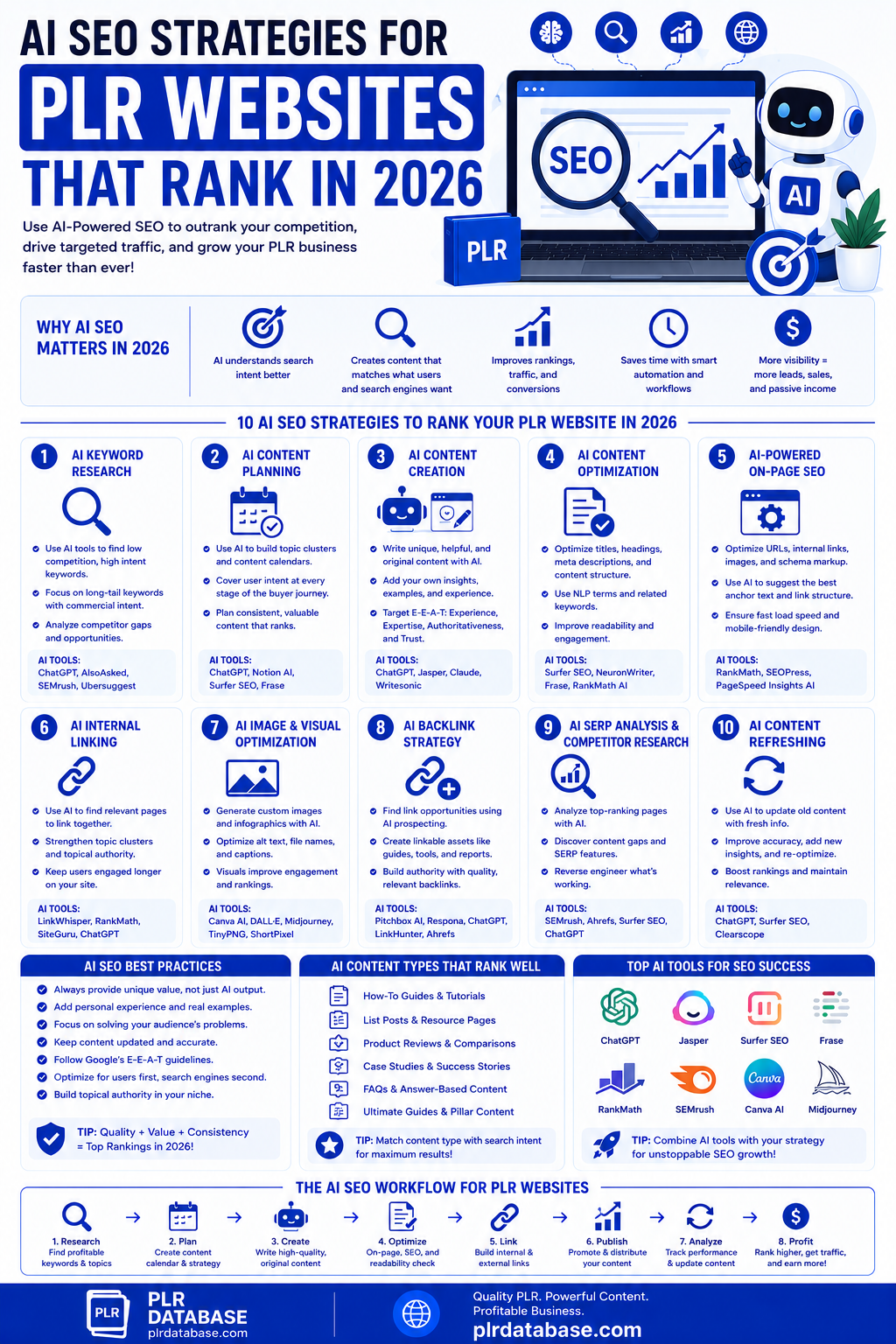
This comprehensive guide teaches you a clear, actionable system to optimize PLR websites for the algorithms of 2026.
You will learn how to build deep topical authority, structure your site for generative crawlers, and create original value that commands organic traffic.
We are moving past traditional on-page tweaks into a new world of algorithmic optimization that turns inexpensive text licenses into highly profitable digital real estate.
In This Article
The Death of Traditional Search and the Rise of Answer Engines
We have officially entered the era of Answer Engine Optimization (AEO). Modern users rarely scroll through pages of blue links anymore. Instead, they ask conversational questions to AI search assistants that freeze out traditional results by synthesizing data from across the web into a single, cohesive response.
If your website wants to be chosen as a primary source for these AI summaries, your content must possess undeniable authority and clarity. Raw PLR material is written to be intentionally broad and sterile so that it can apply to a massive market.
This means it completely lacks the semantic density required to win a citation slot in a modern search breakdown.
To succeed in this landscape, you have to understand that generative engines evaluate websites based on their unique contribution to the web's knowledge graph. This metric is known as Information Gain. If your site merely repeats facts that are already indexed on high-authority platforms like Wikipedia or major media outlets, you offer zero incentive for an algorithm to crawl you.
Re-engineering your PLR content using advanced artificial intelligence allows you to transform standard textbook definitions into highly specialized, data-backed perspectives. This optimization turns a cheap commodity text into a prime algorithmic target that commands visibility.
Furthermore, user interaction signals have become a massive ranking factor. When an answer engine provides a snippet of your site, it tracks how users engage with the subsequent click-through. If a visitor lands on your page and encounters a giant, unformatted wall of generic text, they will bounce back to the search chat instantly.
By using intelligence tools to optimize the readability, structure, and scannability of your pages, you keep users engaged longer.
This signals to the algorithm that your domain is a high-signal resource, creating a compounding ranking effect that steadily pushes your PLR site ahead of massive, legacy competitors.
Step 1: Semantic Mapping and Topical Blueprint Engineering
The baseline of a profitable 2026 SEO strategy is a concept called Topical Blueprint Engineering. Most amateur PLR site owners buy a package of fifty articles on a topic like "Digital Marketing," hit publish on all of them simultaneously, and hope for the best. This chaotic approach creates massive internal competition and confuses search crawlers.
To build a highly rankable domain, you must use a reasoning engine to analyze your entire PLR library and construct a strict semantic map.
This blueprint dictates exactly how every piece of content fits together into a logical hierarchy of pillars, sub-pillars, and supporting assets.
Start by feeding the titles and core summaries of your PLR assets into a high-reasoning model. Instruct the AI to act as a master data architect whose job is to organize these loose files into distinct "Topic Clusters."
For instance, if you are building an authority site in the personal finance space, the AI will cluster your generic articles into specific silos like "Tax Optimization for Solo Creators" or "Predictive Micro-Investing Strategies."
By organizing your licensed material into tightly knit clusters before publishing, you establish clear entity relationships that modern search bots can map in a single crawl.
Once the semantic map is engineered, you must use your AI stack to design a flawless internal linking framework. Do not just link arbitrary pages using generic anchor text like "click here." Instruct your AI to analyze the semantic context of each article within a cluster and generate highly specific contextual links.
A pillar page about asset protection should naturally link down to a supporting article regarding corporate structures using anchor text that explicitly states the entity relationship.
This structured internal flow proves to search engines that your site possesses exhaustive, organized knowledge on a topic, forcing the algorithm to reward your domain with superior topical rankings.
Step 2: Algorithmic Upgrading and Information Gain Injection
With your topical blueprint locked in, you must execute an aggressive algorithmic upgrade on every piece of text in your library. Raw PLR is inherently static and historical; it represents an average of information from the time it was written.
To make this text perform in modern search, you must inject fresh data loops and original insights that cannot be found anywhere else.
This phase is about moving the content from standard information to specialized wisdom, which is the only form of text that answer engines care about indexing.
The implementation of this upgrade requires you to use a search-enabled model to run a comparative gap analysis on your text.
For example, if your PLR article details the baseline principles of customer retention, instruct your AI to search the live web for the absolute latest case studies or market reports published within the last few months.
Have the model insert these specific metrics naturally into the copy. When your article can cite a brand-new study by a major analytical firm, it immediately leaps past legacy blogs that are still relying on outdated information from five years ago.
The second half of the upgrade involves what direct-response marketers call "Perspective Injection." Tell your AI to apply a distinct, highly authoritative persona to the text.
If the PLR describes a common strategy in your niche, instruct the AI to analyze why that strategy might fail in the current economic climate, or provide a contrarian take that challenges industry norms.
This creates an immediate pattern interrupt in the copy. You are using the AI to do the intellectual heavy lifting of expanding and contrasting the safe, sterile PLR text until it becomes a highly opinionated, data-backed authority asset that search bots recognize as completely original.
Step 3: Entity Optimization and Answer Engine Architecture
The final step in our optimization system requires you to completely restructure the technical presentation layer of your pages to appeal directly to conversational search bots.
In 2026, search algorithms do not just read text; they look for clear "Entities" (people, places, concepts, tools) and map the explicit connections between them.
To maximize your visibility in AI-generated summaries, you must use your artificial intelligence tools to format your content using an optimized Answer Engine Architecture.
To execute this architecture, instruct your model to scan your rewritten text and generate "Semantic Headings." These are H2 and H3 tags that perfectly mirror the conversational long-tail questions that users ask their AI search assistants.
Instead of a generic heading like "SEO Tips," your AI should write a highly specific heading like "How Semantic Entity Mapping Reduces Keyword Cannibalization in Content Silos." Underneath each of these semantic headers, instruct the AI to draft a highly concise, two-to-three-sentence summary box. This box acts as an optimized target snippet that an answer engine can easily scrape and display as a direct citation.
Furthermore, you must back this structural formatting with advanced schema markup. Use your AI stack to automatically generate comprehensive JSON-LD schema files for every page on your site.
This structured data should explicitly define the main entities discussed in the article, their properties, and their relationships to other recognized concepts on the web.
When you combine semantic headers, optimized snippet boxes, and pristine schema markup on a single page, you remove all technical friction for search crawlers.
You are essentially handing the algorithm a perfectly pre-digested answer, making your PLR site the absolute easiest choice for an AI assistant to recommend.
The 2026 AI SEO Stack: Practical Tools and Implementations
Running a high-yield PLR website without drowning in administrative manual labor requires a specialized stack of connected artificial intelligence tools. For the initial phase of semantic mapping and high-level structural logic, a high-reasoning engine like Gemini 3 Flash is your ideal foundation.
Its massive context window allows you to upload an entire fifty-article PLR package at once, commanding the model to analyze the cross-conceptual relationships and engineer a flawless topical cluster map in a single pass without losing track of any internal data threads.
When you transition into the content rewriting and snippet formatting phase, you should deploy search-enabled applications to handle the data modernization.
Tools with live web access act as your automated research editors, scouring the internet to find the freshest statistics and citations to inject into your PLR skeletons.
For visual entity optimization, you can use generative graphics suites to automatically construct matching infographics and diagrams that map out complex arguments visually. This visual integration acts as a powerful pattern interrupt that lowers your bounce rates and satisfies mobile users.
For a realistic scenario, consider a digital publisher who acquires a PLR package on real estate investing. By deploying this modern tools stack, the marketer can drop the unedited articles into an automated pipeline.
The reasoning engine maps out the topical clusters, the search AI updates all property metrics and financing laws to clear standards, the copywriting engine refines the text into an authoritative investor voice, and the system automatically generates optimized schema code and semantic headings.
Within a few hours of setup, a static digital file is transformed into a dynamic, rankable web asset optimized to catch waves of high-intent search traffic.
Five Fatal SEO Mistakes That Destroy PLR Websites
The most prevalent mistake is publishing raw PLR without information gain. Many marketers still assume that search engines only care about unique phrasing, so they use simple rephrasing software to beat plagiarism checks.
In 2026, if your content passes a plagiarism checker but offers the exact same semantic value and logical flow as five hundred other blogs, answer engines will flatly ignore your domain.
You must use high-reasoning AI to completely restructure the copy, inject fresh market metrics, and pivot the target audience angle to ensure your page provides a genuine, unique contribution to the web.
Second is allowing robotic language patterns to compromise readability. If your automated content refinery outputs text littered with predictable machine phrases like "it is crucial to remember," "in this digital landscape," or "delve into," search bots will recognize the generic footprint and downgrade your domain's trust score.
Furthermore, human readers find this clinical writing style highly unengaging, leading to immediate bounce responses that crush your ranking signal.
You must implement strict negative parameters within your AI workflow that ban this over-saturated machine vocabulary, forcing the model to produce sharp human prose.
Thirdly, many site owners completely neglect mobile scannability. A massive percentage of conversational search queries originate from mobile screens where users are scanning for instant clarity.
If your optimized PLR site features long, blocky, five-sentence paragraphs that look like academic text blocks on a smartphone, your bounce rate will skyrocket. You must explicitly prompt your writing engine to apply a mobile-first prose style.
Insist on short sentences, frequent paragraph breaks, bolded key takeaways, and clear visual breaks that allow a user's thumb to move through the content seamlessly.
Fourth is failing to challenge foundational PLR data errors. When you purchase a PLR pack, you have no way of knowing if the original anonymous writer pulled their statistics from a reputable source or simply made them up to fill space.
If you allow your AI to rewrite a factual error without verifying the underlying claim against the live web, your site becomes a distributor of misinformation.
In the current age of search, accuracy is a hard ranking factor. You must treat your AI tool as a strict editor that aggressively challenges and updates every metric before it goes live.
Finally, the mistake of passive internal linking will limit your organic growth. Many site owners automate their publishing schedule but leave their internal links to basic plugins that randomly connect pages based on simple keyword matches.
This chaotic linking architecture destroys your topical authority and prevents search engines from understanding your cluster maps.
Internal links must be deliberate, structural, and contextually dense. You must use a reasoning engine to analyze the semantic relationships between your pages, ensuring that every internal link clearly maps an entity connection that supports your broader topical blueprint.
Conclusion: Your 2026 Action Plan: Your Blueprint for Algorithmic Dominance
Building a profitable PLR website that dominates the modern search landscape is an exercise in precise, automated execution. The era of manual content churning is gone, but the opportunity for high-speed content architects has never been greater.
By leveraging the modular system of semantic mapping, live data modernization, and answer engine formatting outlined in this guide, you can continuously launch highly competitive niche properties that out-rank legacy competitors in a fraction of the time.
Your 30-Day Launch Action Plan:
- Days 1–7: Audit and Structural Engineering
Audit your existing licensed library or purchase a high-quality, evergreen PLR bundle in a proven market demand. Feed your asset list into a high-reasoning engine to extract a clean knowledge graph, organize the loose files into explicit topical clusters, and map out your precise internal linking framework.
- Days 8–15: Algorithmic Content Transformation
Deploy your automated writing engine to process your clusters section by section. Use a search-enabled tool to run live-web checks on every claim, replacing outdated statistics with current citations. Instruct the AI to apply a distinct brand voice persona and inject contrarian angles that ensure absolute semantic uniqueness.
- Days 16–22: Answer Engine Optimization Formatting
Format your transformed text using a mobile-first, highly scannable layout. Instruct your AI to generate long-tail semantic headers that mirror modern search queries, draft concise snippet summary boxes under each header, and build custom schema markup scripts to anchor your entity relationships within the page code.
- Days 23–30: Visual Integration and Deployment
Deploy your visual generation engine to create branded graphics and infographics that visually represent the structural entity maps of your text.
Assemble your final pages within your publishing platform, run a definitive quality editing pass, and launch your automated content machine to the search index.
By adhering to this packaged framework, you cease to be a passive reseller of generic digital text. You become a highly strategic content architect, using advanced artificial intelligence to maximize your operational efficiency while building premium digital real estate that captures high-intent traffic and scales your revenue on autopilot.
The blank page is a relic of the past; it is time to build your empire.
About the Author








0 Comments
Start The Conversation